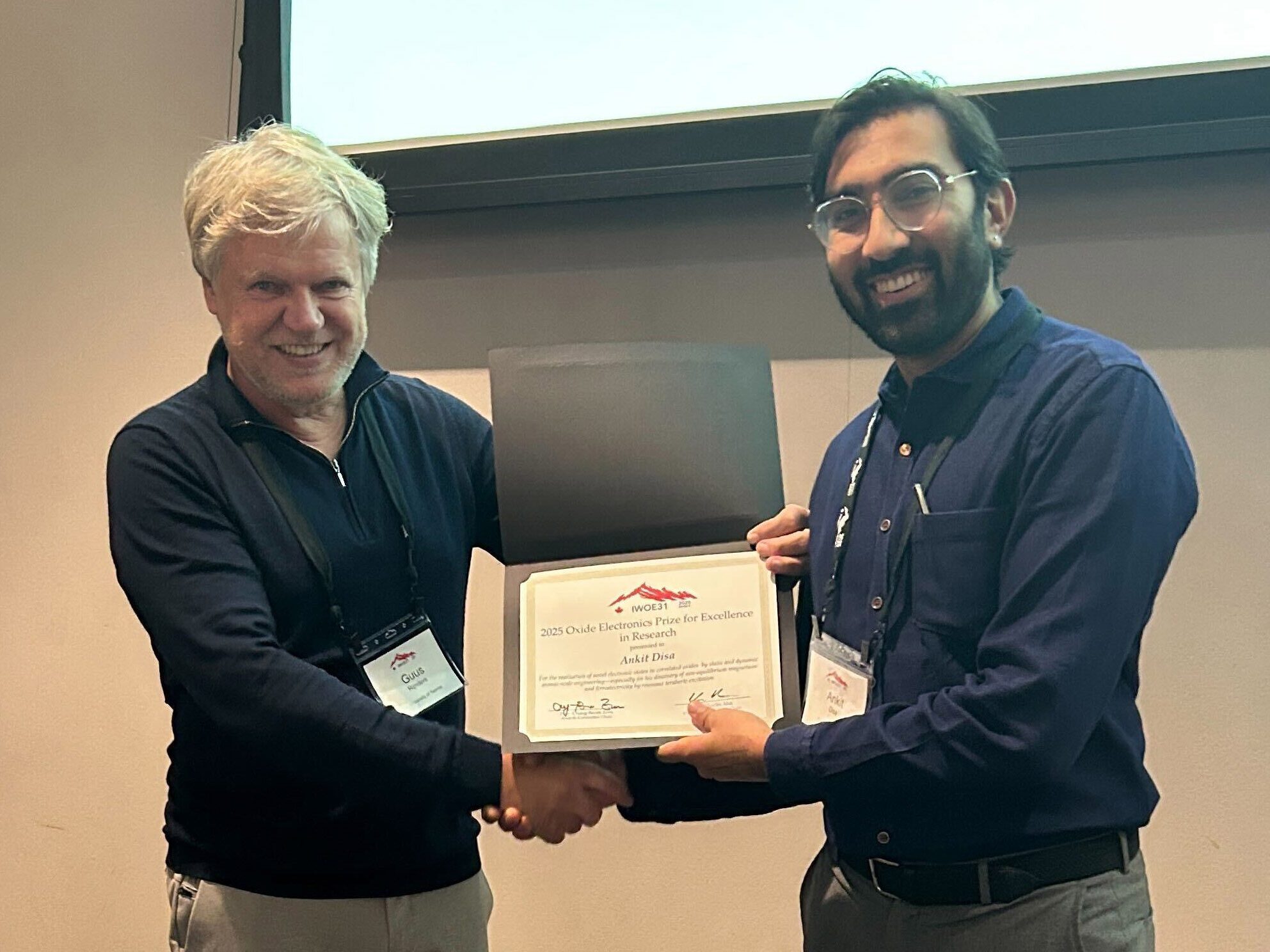
In recognition of his groundbreaking contributions to oxide electronics and quantum materials, Ankit Disa, assistant professor in the School of Applied and Engineering Physics, was awarded the prestigious Oxide Electronics Prize for Excellence in October, 2025. The honor is presented annually at the International Workshop on Oxide Electronics, the leading global forum for research on functional oxides.
Disa was cited “for the realization of novel electronic states in correlated oxides by static and dynamic atomic-scale engineering—especially for his discovery of non-equilibrium magnetism and ferroelectricity by resonant terahertz excitation.” The selection was made by a committee of internationally recognized scientists in the field. Disa’s nomination letter noted that throughout his career he has made “significant and wide-reaching contributions to the control of electronic properties in correlated oxides” and described him as “an innovative researcher and leader who will continue to shape the field of oxide electronics for years to come.”
Disa’s research has focused on manipulating the functional properties of quantum materials on the smallest length and time scales, particularly complex oxides. “These materials host some of the most intriguing phenomena in condensed matter physics, including high-temperature superconductivity, quantum magnetism, and multiferroic behavior,” Disa said. “My early work utilized atomic scale synthesis of oxide heterostructures to optimize electronic transport properties. More recently, I have been interested in how to dynamically manipulate the properties of these materials by exciting them with ultrashort laser pulses.”
During his doctoral research, Disa pioneered atomic-scale synthesis techniques for complex oxide heterostructures using molecular beam epitaxy. His work on rare-earth nickelates led to the creation of “tri-color” superlattices, a powerful new platform for engineering electronic states in layered materials. These structures achieved record orbital polarizations and provided key insights into nickelate systems closely related to cuprate superconductors. He also designed two-dimensional metallicity, hidden magnetic order, and non-volatile switching behavior in nickelate-based systems. As a postdoctoral fellow, Disa expanded this approach by introducing ultrafast light pulses to manipulate crystal structures dynamically. Applying tailored terahertz laser sources to correlated oxides led to the realization of groundbreaking non-equilibrium phenomena, including metastable light-induced ferroelectricity in strontium titanate, ultrafast antiferromagnetic switching, and optically driven ferromagnetism in yttrium titanate at temperatures more than three times its equilibrium Curie temperature. These results showed how light could fundamentally transform the properties of materials.
At Cornell, Disa is pursuing a long-term vision for next-generation quantum oxide electronics based on non-equilibrium materials design, combining atomic-scale thin-film growth with targeted optical excitation to create materials whose electronic and magnetic behavior can be switched at ultrafast timescales. This approach has the potential to enable new classes devices that could operate far beyond the limits of conventional semiconductor technology.