As an undergraduate at UC Berkeley in the late 1960s, William “Bill” White read academic papers about sea floor spreading and gravity anomalies written by Harry H. Hess, who became known as one of the founding fathers of the modern theory of plate tectonics.
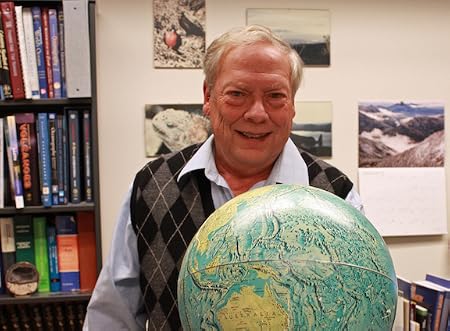
Decades later, White, professor emeritus in Cornell’s Department of Earth and Atmospheric Sciences, has been awarded the Harry H. Hess Medal by the American Geophysical Union (AGU), recognizing his contributions to understanding the chemical evolution and dynamics of the Earth.
The Hess Medal, established by AGU in 1985, is presented annually to a senior scientist for outstanding achievements in research on the constitution and evolution of Earth and other planets. The award recognizes research across fields including geochemistry, petrology, volcanology, tectonophysics, planetary science and the study of Earth’s deep interior. The medal is named for Harry H. Hess, a geologist and geophysicist whose work helped lay the foundation for the modern theory of plate tectonics.
White’s research focused on many of those same fundamental questions, particularly the evolution of Earth’s mantle and the origin of mantle plumes and the volcanoes they produce. He used the chemical and isotopic compositions of volcanic rocks to investigate processes occurring deep within the planet and to reconstruct how Earth’s interior has changed over geologic time.
A central tool in White’s research was radiogenic isotopes – atoms whose abundances change over time as radioactive elements decay. Isotope ratios such as strontium and lead can preserve information about the mantle sources from which volcanic rocks originated. By combining isotope measurements with the concentrations of trace elements in basalts, White studied the composition, structure and long-term evolution of Earth’s mantle.
White earned a bachelor’s degree in geology from the University of California, Berkeley, in 1971 and a doctorate in oceanography from the University of Rhode Island in 1977. He held postdoctoral positions at the Carnegie Institution of Washington and the U.S. Geological Survey in Denver before joining the Max Planck Institute for Chemistry in Mainz, Germany in 1980, where he worked as a staff scientist.
After a year as an associate professor at Oregon State University, White joined the Cornell faculty in 1986. During his Cornell career, he also held visiting appointments in France and returned to the Carnegie Institution of Washington as a Merle Tuve Senior Fellow in 2002.
In addition to his research, White has contributed to the broader geosciences community through scientific publishing and service. He was founding editor of Geochemistry, Geophysics, Geosystems, commonly known as G-Cubed, serving in that role from 1999 to 2005, and has chaired the advisory committee for EarthChem, an international geochemical database initiative. He is a fellow of both the Geochemical Society and AGU and was elected an AGU Fellow in 2002. He received the Harold Urey Medal from the European Association of Geochemistry in 2022
White is the author of the textbooks Isotope Geochemistry and Geochemistry and has published extensively on mantle geochemistry, oceanic island basalts, mantle plumes, isotopes and the composition of oceanic crust.
Recipients of the Harry H. Hess Medal are recognized at AGU’s annual meeting and receive an engraved medal. This honor connects White’s career back to that of a scientist whose work inspired him as he was just getting started.
“I feel greatly honored by this recognition,” White said. “It is something I never would have imagined as an undergraduate at Berkeley in the 60’s reading Hess’s papers as the great Plate Tectonics Revolution was unfolding.”