At Cornell’s Meinig School of Biomedical Engineering, students in the Master of Engineering (M.Eng.) program are learning to navigate healthcare innovation through technical design, collaboration and clinical insight.
That approach was on display during the school’s 10th annual Industry Engagement Day and Project Showcase, held on campus May 15. Organized by Newton de Faria, director of the M.Eng. program, the event brought together students, alumni, faculty, clinicians, industry professionals and corporate partners to celebrate the next generation of biomedical engineering leaders.
The day featured student design demonstrations, poster sessions, industry networking, project presentations, a startup-style pitch competition and panel discussions focused on career development and the future of healthcare technology.
Preparing students to enter the workforce
Attendees also heard from keynote speaker Judi Binderman, M.D., MBA, MHSA, a physician informatics executive at Oracle Health Government Services whose career has spanned medicine, health systems consulting, medical informatics and healthcare operations.
“The education you’ve gotten here and the projects that you have been working on… are teaching you a set of skills and giving you a toolkit that not many other courses of study have,” Binderman told students during her keynote address. Drawing from her own nonlinear career path from engineering student to physician and healthcare technology consultant, she encouraged graduates to remain adaptable and mission-driven as they enter the workforce this summer.
“You are standing at a doorway,” she said. “Walk through boldly. Don’t be afraid to fail… be afraid not to try.”
Student projects address real healthcare challenges
Throughout the showcase, students presented projects addressing challenges across medical devices, digital health, diagnostics, surgical technologies and biotechnology. Many reflected the interdisciplinary and translational focus that defines Cornell’s biomedical engineering M.Eng. program, where students work through the full innovation pipeline from identifying clinical needs to prototyping and evaluating solutions.
This year’s 12 projects were sponsored by Baxter, Becton Dickinson, West Pharmaceutical, OsteoIQ, Weill Cornell Medicine and Hospital for Special Surgery, with representatives from many of these organizations in attendance.
Focus on women’s health innovation
The showcase also highlighted a growing emphasis within the Meinig School on women’s health and menopause innovation. Three student projects focused specifically on challenges affecting women’s health, reflecting expanding institutional efforts tied to Cornell’s Menopause Health Engineering and Engineering Innovations in Medicine initiatives. The projects explored areas including maternal health, gynecologic care, and technologies designed to improve quality of life and access to care for women across different stages of life.
De Faria said the increasing number of women’s health projects reflects both student interest and broader momentum within healthcare innovation.
“Biomedical engineering has an important role to play in addressing longstanding gaps in women’s health technologies and care delivery,” he said. “Our students are increasingly motivated to work on solutions that improve outcomes and quality of life for underserved patient populations.”
A decade of growth and industry engagement
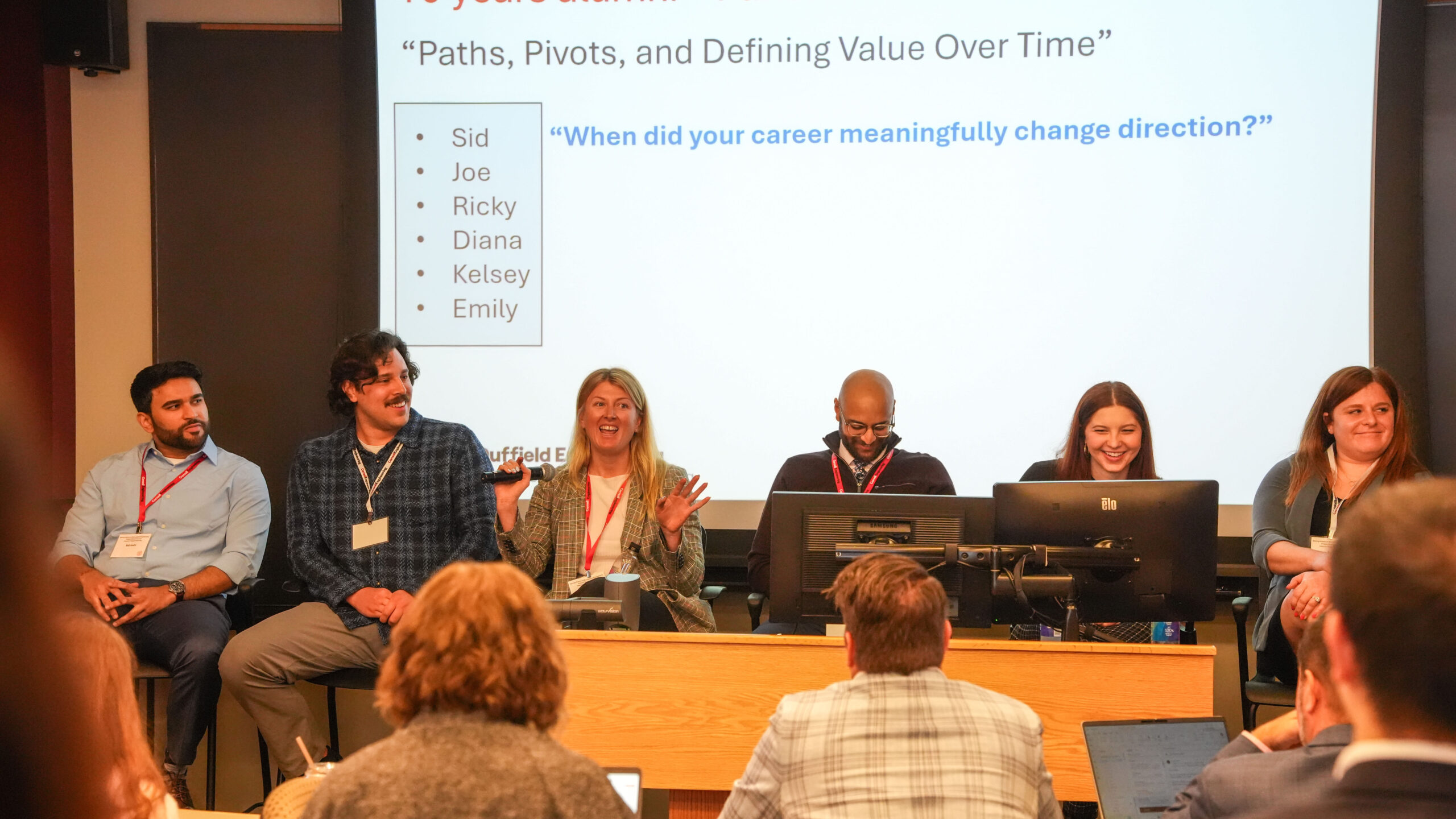
The event also marked an opportunity to recognize the growth of Cornell’s M.Eng. program under de Faria’s leadership over the past decade. During a special session featuring members of the program’s Class of 2016, alumni reflected on how the program’s emphasis on systems thinking, industry engagement and experiential learning prepared them for careers across healthcare and technology sectors.
Industry engagement remains a central component of the program. Throughout the day, students connected with representatives from medical technology companies, healthcare organizations, startups and alumni networks, gaining exposure to career pathways spanning product development, clinical innovation, regulatory strategy, consulting and healthcare operations.
Celebrating innovation and looking ahead
The showcase concluded with a pitch competition and awards ceremony recognizing student teams for innovation, communication and technical achievement.
For students preparing to graduate, the event served as both a culmination of months of design work and a launch point into the evolving biomedical technology landscape.
De Faria said the showcase represents more than a final presentation for students.
“The world, especially healthcare, is in dire need of people like you: individuals capable of thinking critically, navigating ambiguity, collaborating across disciplines, communicating ideas and transforming challenges into meaningful solutions,” de Faria said.

2026 Project Showcase competition winners
Design Competition
Judges evaluated the success of each team’s trajectory through the year on criteria including: business case, engineering, creativity, quality and merit, overall competence in design, and impact.
First place
Design and Validation of a Biodegradable Intervertebral Cage for Biologic Spinal Disc Support
Team: Arian Alhosseini, Maya Geiss, Adam Jac, Kenneth Nicolay, Kidher Rahman, Nathan Zittoun
Second place
Precision Under Pressure: AR Simulation for Postpartum Cesarean Hysterectomy
Team: Omar Abououf, Daniella Ameh, Shreya Dandwate
Third place
Type X: A Novel Design for Point of Care Blood Typing Test
Team: Shruthi Gopi, Binbin Zeng, Ethan Boniuk, Jinwei Xiang, Bojun Yu
Pitch Competition
Judges focus on merit of the invention in the eyes of the stakeholders and investors.
Performance Award
Type X: A Novel Design for Point of Care Blood Typing Test
Team: Shruthi Gopi, Binbin Zeng, Ethan Boniuk, Jinwei Xiang, Bojun Yu
Engineering Excellence Award
Design and Validation of a Biodegradable Intervertebral Cage for Biologic Spinal Disc Support
Team: Arian Alhosseini, Maya Geiss, Adam Jac, Kenneth Nicolay, Kidher Rahman, Nathan Zittoun
Honorable Mention for Simplicity of Design
Innovating Brachytherapy Treatment for Uterine Cancer
Team: Hannah Buchanan, Paul DeSouza, Jennifer Gonzalez