More than 40 students packed a classroom in Rhodes Hall on April 27 to hear five recent alumni of Cornell’s School of Operations Research and Information Engineering reflect on their time on campus and the career paths they have pursued since graduation.
Moderated by professors David Shmoys and David Goldberg, the panel offered a candid look at how studying operations research translates into fields ranging from consulting and airline scheduling to quantitative trading and graduate research. The discussion also provided practical advice for students preparing for internships, full-time roles, and graduate school.
The alumni, who graduated within the past several years, described operations research as a uniquely flexible major that blends mathematics, computing, and business-oriented problem solving. Several said they were drawn to the field after exploring other engineering disciplines or discovering its real-world applications early in their Cornell careers.
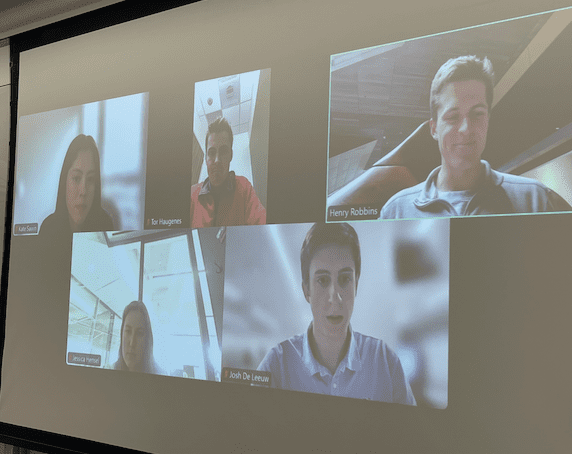
“I found it to be a really interesting mix of engineering and business,” said Kate Sawin ’24, noting that the major’s breadth has allowed her to apply concepts she learned in school to her work at United Airlines. “A lot of what I learned in OR classes is applicable to real-life challenges I face at work all the time.”
Other alumni participants echoed the emphasis on applicability. Henry Robbins ’22 recalled deciding to major in operations research during his first class at Cornell after recognizing how directly the coursework connected to real-world problems. “I was in the required ENGRI class on Day One and I saw the intro to operations research lecture and within 30 minutes of that class ending I decided to major in OR,” Robbins said. “I was drawn to the way the problems were presented, the types of math you were working with, how applicable it was to real world problems.”
Jessica Hensel ’25 credited the program with strengthening her collaboration and communication skills, which she said are essential in consulting and team-based environments. Hensel now works for the consulting firm McKinsey.
Throughout the evening, panelists highlighted how the concept of optimization appears in many professional settings, even when not labeled explicitly. Sawin described her role in airline network planning, where she helps determine how to allocate aircraft across routes to maximize profitability under operational constraints. “It’s just a big puzzle a lot of the time,” Sawin said, explaining how decisions about routes, aircraft types and demand patterns mirror the optimization problems studied in class.
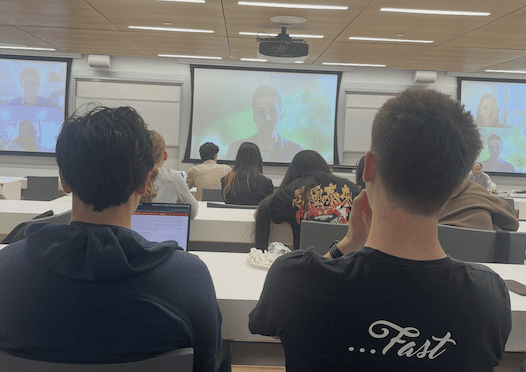
Robbins shared his experience as an applied scientist at Uber, working on ride-sharing algorithms that determine how long to wait before matching passengers. The problem, he explained, involves balancing efficiency, customer experience and system-wide network effects — all hallmarks of operations research-style thinking.
Beyond technical applications, the panel focused heavily on career preparation. Alumni emphasized the importance of networking, particularly leveraging Cornell connections, and encouraged students to be intentional in their job searches.
“If the choice is applying to 20 jobs or applying to five but then reaching out to someone … I would choose the latter,” Josh De Leeuw ’25 said, noting that alumni are often eager to help fellow Cornellians. De Leeuw is a quantitative trader at Susquehanna International Group.
Several panelists also discussed how to explain ORIE to employers unfamiliar with the major. Rather than focusing on technical terminology, they recommended highlighting concrete skills — such as programming, data analysis and modeling — along with project experience.
For students considering consulting, Tor Haugenes ‘24 advised preparing thoroughly for case interviews and targeting firms that value operations-focused skill sets. Haugenes is now a consultant with Deloitte. Others encouraged students to explore less traditional opportunities and remain open to roles that may not be widely discussed among peers.
The conversation also turned to graduate school, with Robbins, who is currently a Ph.D. student at Stanford University, urging students to consider gaining industry experience before pursuing a Ph.D. “Working on real-world problems can provide valuable perspective on which research questions matter most,” Robbins said.
Throughout the discussion, panelists returned to a common theme: the importance of exploration during college. They encouraged underclassmen to try a wide range of activities early on, then focus more deeply on specific interests later. “Take as many different classes and try as many things as you can,” De Leeuw said. “That’s how you figure out what you’re actually interested in.”
Hensel concurred, adding that one piece of advice she would give to her younger self (or to anyone currently majoring in operations research) is to enroll in ORIE 4999 early in one’s academic career. In 4999, students work on a project under faculty supervision to tackle a real problem existing in some firm or institution. “It’s an easy way to get exposure to what research is like,” Hensel said. “So I would highly recommend doing that early, because if you do really like it, then you have time to take it more semesters.”
At the same time, students were urged to step outside their comfort zones — whether by studying abroad, joining new organizations, or pursuing unconventional opportunities — and to take advantage of leadership roles as they progress through their time at Cornell.
The panel concluded with reflections on the growing influence of artificial intelligence in the workplace. While panelists agreed that AI is becoming an important tool, they emphasized that it complements rather than replaces foundational skills in problem solving and critical thinking.