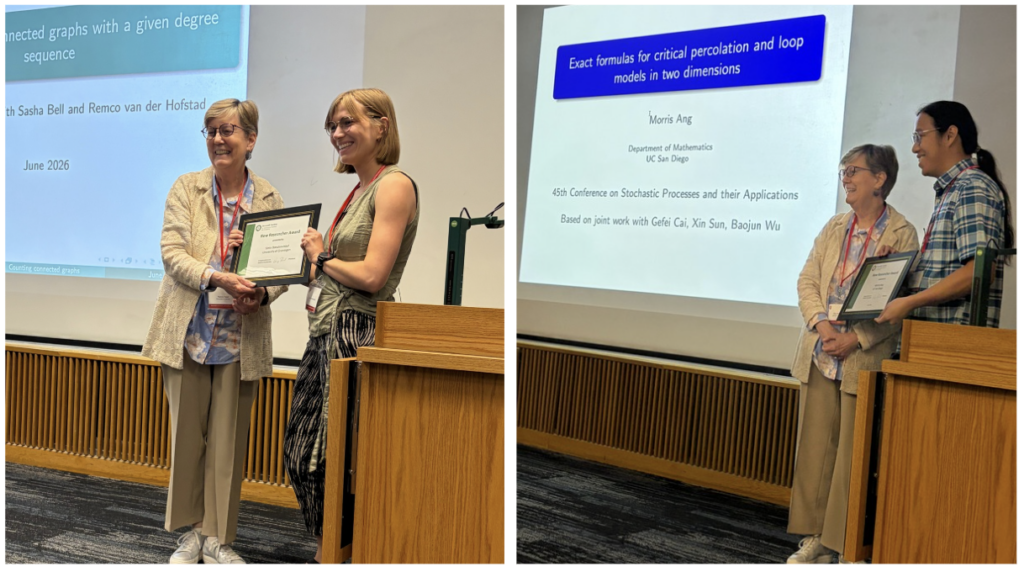
More than 100 researchers from around the world gathered at Cornell University June 14–20 for the 45th Conference on Stochastic Processes and Their Applications (SPA 2026), one of the world’s leading annual conferences in probability theory. Held under the auspices of the Bernoulli Society and supported by the Institute for Mathematical Statistics, the conference showcased the latest advances in stochastic processes and their applications across mathematics, statistics, engineering, finance, physics and related fields.
The conference was co-hosted by Gennady Samorodnitsky, the Charles W. Lake, Jr. Professor in Productivity in Cornell’s School of Operations Research and Information Engineering and Laurent Saloff-Coste, the Abram Rogers Bullis Professor of Mathematics in Cornell’s Department of Mathematics. Together, they led the local organizing committee that brought the international meeting to Ithaca.
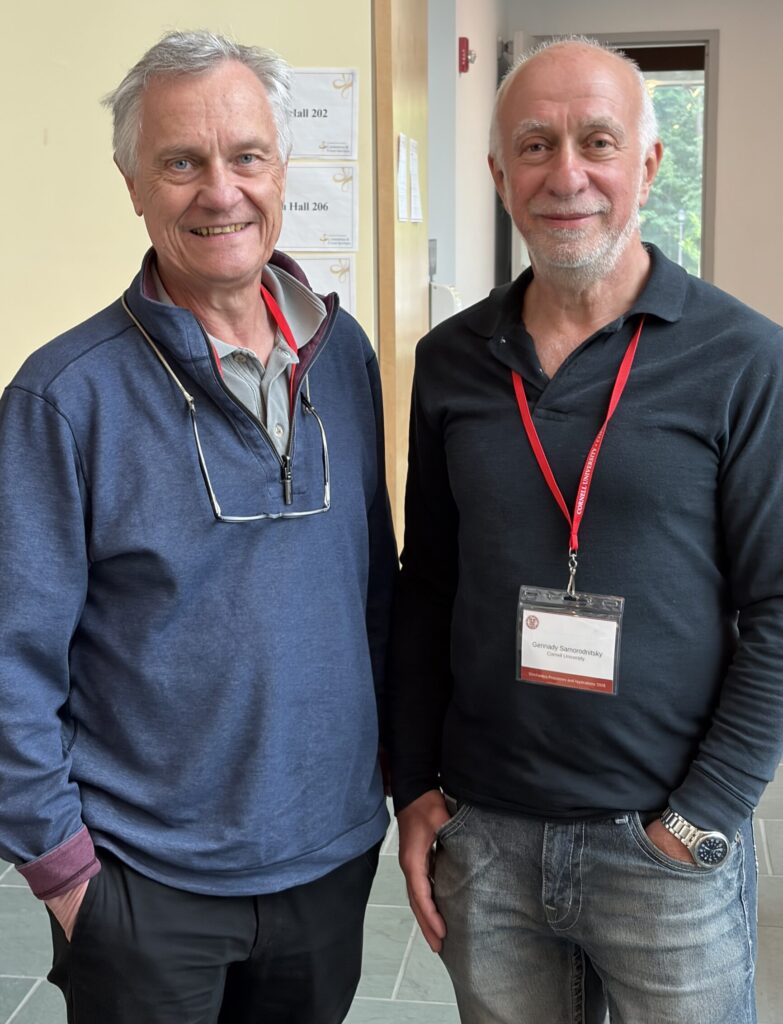
According to Samorodnitsky, hosting SPA at Cornell had been years in the making. After an earlier proposal to host the conference in 2025 was unsuccessful, organizers secured the 2026 meeting and began planning an event that would reflect Cornell’s longstanding strength in probability and stochastic processes.
The weeklong conference featured plenary lectures by internationally recognized researchers, invited and contributed sessions covering a broad range of topics, and opportunities for graduate students and early-career researchers to present their work. The scientific program explored subjects ranging from random fields and random environments to statistical physics, stochastic analysis and other rapidly developing areas of probability research.
Although international travel challenges prevented some researchers from attending, Samorodnitsky said the conference was a success. “We were happy,” he said. “All the feedback I got was very, very positive. By all the criteria I have, it went well.”
The conference also gave Cornell graduate students the opportunity to interact with many of the field’s leading researchers without leaving campus, strengthening connections within the international probability community.
“The quality of the talks was high,” Samorodnitsky said. “People enjoyed being there.”
Support for SPA 2026 included funding from the National Science Foundation, Cornell’s School of Operations Research and Information Engineering, the Department of Mathematics at Cornell, and conference registration fees.