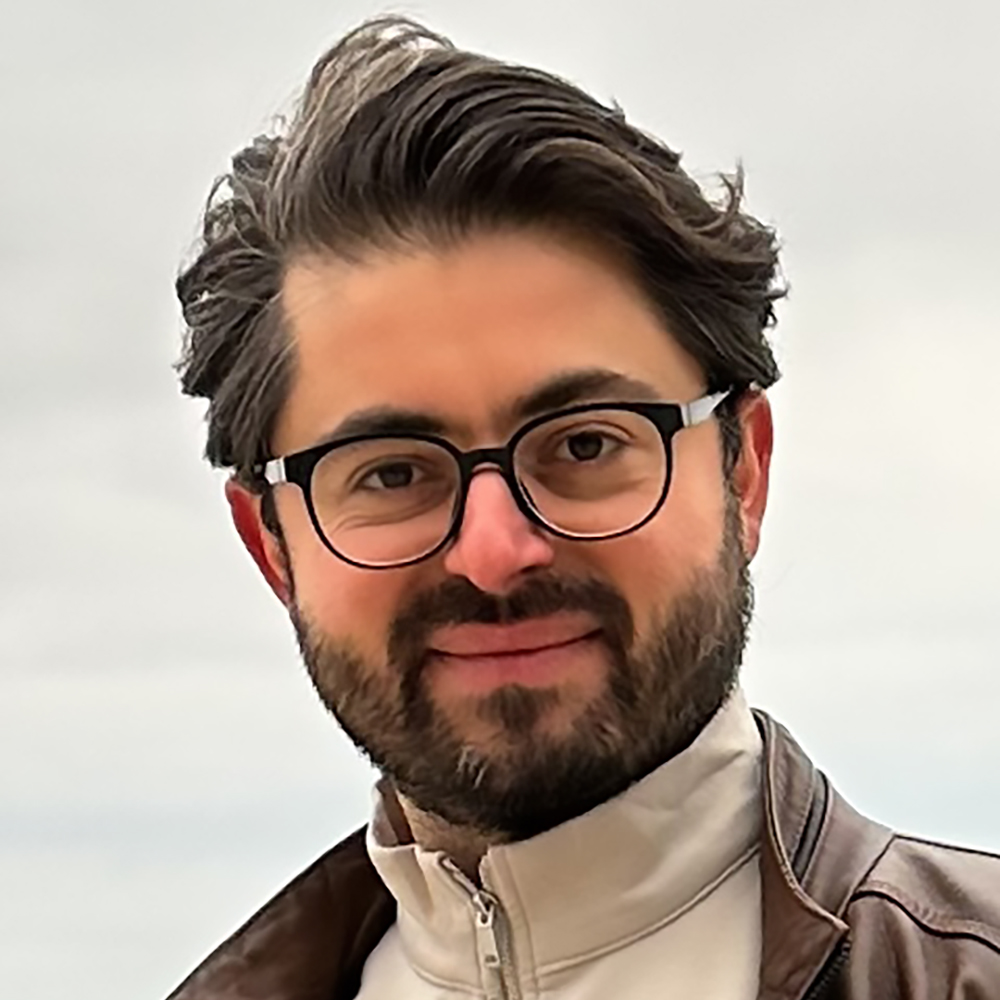
Did you have a plan for your career from an early age that you followed to success, or did you make the most of opportunities as they arose, acquiring insight, skills and clarity along the way? If the latter, you are in good company. More people have career trajectories that are likely to take unexpected twists and turns than to follow a straight line. Similarly, the academic and professional journey of Ramis Movassagh ’04 is a story of opportunistic success achieved through perseverance, academic ability, and a positive attitude, facilitated by a B.S. in engineering physics.
Upon entering Cornell, Movassagh paradoxically avoided physics even though he always loved theoretical physics. Although he was concerned that a degree in theoretical physics would not lead to many job prospects, he eventually found employment in mathematical physics, a field even more abstract and rigorous than theoretical physics.
“It’s funny,” he said. “In theoretical physics, you don’t have to prove what you do, as long as it confirms existing experiments. But in mathematical physics, having a good heuristic argument is not enough, you also must rigorously prove your ideas. And this is especially important in quantum computing, a still-developing field, which demands firm theoretical foundations before experimental confirmation is possible.”
So, how did Movassagh transition from an applied physics degree to a theory-focused career?
Although many students find Cornell academically challenging, for Movassagh, it was particularly so. He had immigrated to Canada from Iran with his family when he was 14 and started learning English at that time. As an international student, even the process of getting to Cornell was challenging. Not understanding the importance of the immigration form known as an I-20, Movassagh flew from Calgary to Syracuse, only to discover that without an I-20, he was not allowed to leave the airport. After several collect calls to his parents and Cornell, his I-20 was faxed to the airport, and he was able to get a ride to Ithaca to start his academic journey.
Arriving the day before the start of classes, he met an electrical engineering professor who helped him with his course registration. But within two weeks, Movassagh started questioning whether electrical engineering was a good fit. About that time, he discovered Cornell had a School of Applied and Engineering Physics, so he sought out Professor Frank Wise to learn more about this field. As a result of this meeting, he decided to study engineering physics instead, where he was advised by Professor Richard Lovelace.
“I thought that engineering physics was just a more difficult version of physics with an engineering component,” he said. “But it became clear to me that with an engineering physics degree, I could not only pursue electrical engineering, but also many other fields. It seemed like a perfect compromise between career opportunities in engineering and my love of physics and math.”
Movassagh immersed himself in both theory and experimentation, supporting himself through research and extensive teaching. He took numerous math courses in addition to his engineering physics curriculum and participated in a broad range of research projects: particle physics (at Princeton the summer of his sophomore year), and crystallography, microfluidics, and atmospheric plasma physics at Cornell. He also was a teaching assistant for six different undergraduate courses and a graduate course, from classical mechanics to solid-state physics. His drive to work hard and take on many responsibilities was partly driven by necessity (he has been financially independent since age 15), but also by a genuine passion for teaching and learning.
As a self-described “ambitious person,” Movassagh made a point of seeking out and connecting with the most renowned figures in their fields during his time at Cornell. He recalled walking into Nobel Laureate Roald Hoffmann’s office one day without an appointment and striking up a conversation—one that blossomed into a lifelong friendship and research collaboration. A similar situation occurred with the Fields medalist William Thurston and Nobel laureate physicist Hans Bethe.
“I really wanted to meet Bethe,” he said, “So I went to his office, but was told he no longer came to the office because he was 96 years old at the time. The receptionist told me I could send him a fax or letter, since he was ‘allergic to computers’ and did not use email. So, I sent him a fax with my phone number, asking if we could meet. One night I got a call from his wife, Rose Bethe, and she arranged a meeting for us at their house. I had a very pleasant discussion with Hans Bethe, and he also cracked jokes and gave me advice.”
Their conversation left a deep impression on Movassagh. “I like to interact with exceptional people because of the advice they can provide,” he said. “That has helped me tremendously, especially in the early stages of my career. It was helpful to discover that there are so many people who are willing to share their wisdom and experiences, and this can help you learn how to find your own direction.”
On Roald Hoffmann’s recommendation, Movassagh went to Switzerland after graduation to work in a neuroscience research group. What was supposed to be a six-month stint turned into a two-and-a-half-year stay, during which he published multiple papers.
He considered staying in Europe and pursuing a Ph.D. at the Swiss Federal Institute of Technology in Zurich with the eminent mathematical physicist Jürg Fröhlich. Yet, he ultimately chose to return to the U.S. to pursue a Ph.D. in mathematics at MIT. Although trained as a physicist, Movassagh committed to working under Peter Shor, one of the founders of quantum computing, where he focused on mathematical physics of quantum many-body systems, the complexity theory of quantum systems, and the development of quantum algorithms. This leap into a domain grounded in mathematical rigor and theoretical computer science was a significant departure from his academic background.
Following his Ph.D., Movassagh held several research positions, including a Goldstein Fellowship at IBM’s Thomas J. Watson Research Center. There, he published foundational work in quantum computing and worked with leading figures like Sergey Bravyi. After five and a half years, Movassagh transitioned to Google’s quantum computing group in Santa Monica, continuing his research on algorithms, cryptography, and computational complexity.
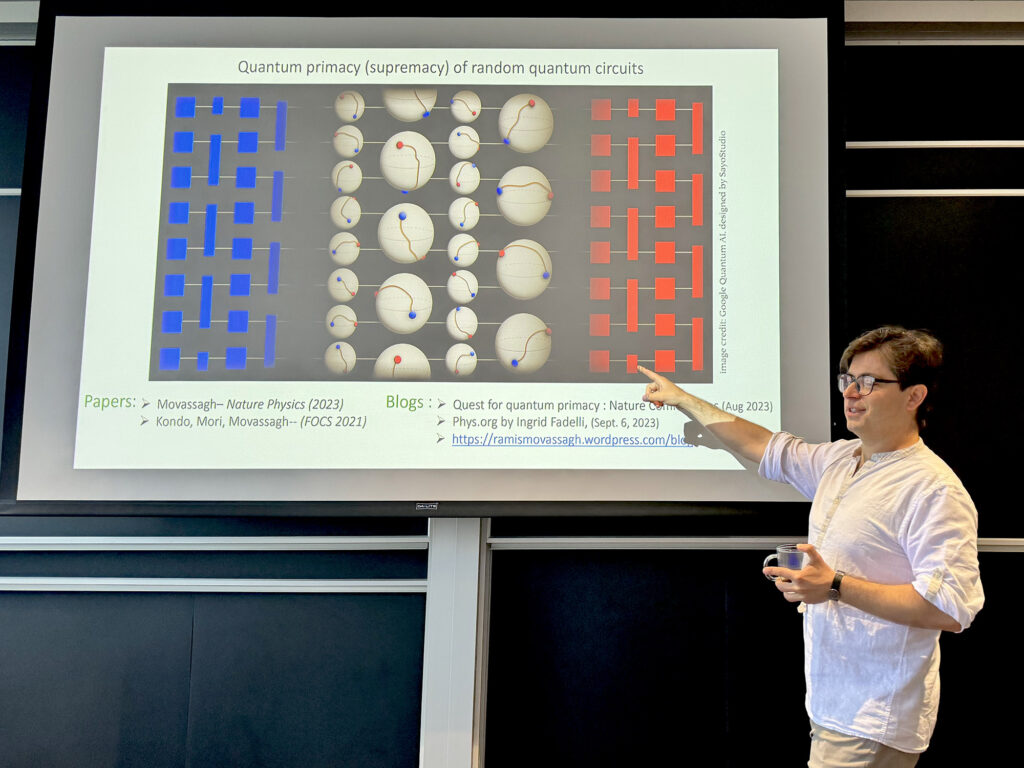
Even though he works in industry—first at IBM and Google, and now at IonQ where he is the senior director of quantum finance—Movassagh’s role has been very similar to that of a university research scientist, focused on scientific questions and driving research. As a quantum researcher, he works on the theory of quantum computing, designing new algorithms to prove whether something works or not, or proving the theory underlying quantum advantage—determining when and why quantum computers can outperform classical systems.
“Ironically, I ultimately ended up becoming very mathematical and a theorist,” he said, “but I think that the experimental background I received in engineering physics was nevertheless very valuable, because it allowed me to gain an appreciation for the reality of things—how research is done in the lab, how to think about a problem, and how to identify a good problem that will lead to useful experiments and applications versus a question that’s just of theoretical interest.”
For current and prospective students, Movassagh shares this advice: “Reach out and interact with accomplished people and pay attention to their suggestions and guidance. That helped me a lot, especially in the early stage of my career. They have unique life trajectories, experiences, and wisdom that can help you, providing you with unforeseen opportunities.”