Upscaling, Symbolic Deduction and AI: New Opportunities for Multiscale Systems Modeling of Reactive Transport in Porous Media through AI-parametrizable Symbolic-Numeric Software
Geologic porous media have played and continue to play a critical role in the energy transition, as the physical domains from which resources can be harvested, CO2 sequestered and H2 stored. Modeling and prediction of fluids and reacting species in the subsurface continues to be a major open challenge in computational physics because of the inherent multiscale nature of geologic porous media, where the relevant scales of interest can easily span 10 orders of magnitude. Despite advances in the development of multiscale models of flow and reactive transport in geologic porous media, significant challenges remain in the rigorous derivation of continuum models themselves, and their numerical implementation, verification and parametrization, particularly in presence of systems of realistic complexity (e.g. tens of reacting species/minerals). The derivation and numerical implementation of macroscopic models from their fine-scale counterpart through formal upscaling techniques can take many years of concerted efforts between applied mathematicians, modelers and computational physicists to develop. These efforts can become daunting for systems of realistic complexity, such as reactive single- and multi-phase transport in geologic media in the context of CO2 sequestration, H2 storage, etc. Differently from data-driven methods, recent works from our group have shown that purely deductive algorithms, implemented in symbolic computing software, can be used to augment and boost human deductive capabilities through the automation of rigorous (mathematical) upscaling theories. Allocating to the machine time-consuming and error-prone laborious procedures allows one to speed up the time to derive upscaled equations by 5 orders of magnitude, compared to the same calculations performed by a human. Although the generated macroscopic systems of equations are accurate within estimated upscaling errors, the massive and complex differential equations are still difficult to handle for the purpose of numerical implementation and verification. To tackle this problem, we propose the first symbolic-numeric framework fully integrating automated symbolic deduction capabilities for multiscale model development and automated numerical code generation, which can be run with minimal human interaction. Finally, we demonstrate how ML tools can be seamlessly and effectively incorporated in the multiscale model generation workflow for their quick topology-aware parametrization.
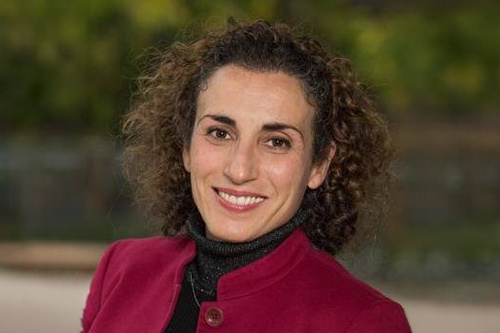
Bio: Ilenia Battiato is an associate professor of energy science and engineering at Stanford University and leads the Multiscale Physics in Energy Systems Laboratory. Her research focuses on understanding, modeling, and predicting complex multiscale multiphysics systems with cross-cutting applications in the energy landscape ranging from electrochemical storage to CO2 sequestration and H2 storage in the subsurface. She obtained a M.S. in environmental engineering with highest honors from the Politecnico di Milano, Italy. Subsequently she obtained a M.S. in engineering physics from the Department of Mechanical and Aerospace Engineering at University of California at San Diego as well as her Ph.D. in engineering science with spec/computational sciences. She held a postdoctoral position at the Max Planck Institute for Dynamics and Self-Organization in Goettingen, Germany. Prior to joining Stanford, she was faculty in the Department of Mechanical Engineering at Clemson University first, and then at San Diego State University. She received the DOE Young Investigator award in Basic Energy Sciences for her work on multiscale models in porous media and has been awarded the Frederick Emmons Terman Fellowship at Stanford University, as well as the 2026 Interpore Award for Porous Media Research. She is also the current elected vice chair of the Gordon Research Conference for Flow and Transport in Permeable media alongside Inga Berre.