Towards Reliable and Safe Autonomy for Aerospace Vehicles
Autonomous aerospace vehicles have applications in diverse fields like space exploration, disaster monitoring, infrastructure inspection, transportation and defense. However, despite several years of research on autonomy of aerospace vehicles, substantial challenges remain in achieving safe and reliable autonomy. The biggest challenges in integrating autonomous aerospace vehicles into human society have to do with dynamic uncertainties due to natural (environmental) effects and changes in internal parameters, safe navigation in cluttered or contested environments, and safe and reliable interactions with humans. Recent advances in learning-based and data-enabled control and navigation have made it possible to deal with some of these challenges. However, many of these approaches lack performance guarantees like nonlinear stability and robustness to external or internal uncertainties, which are needed to meet use-based requirements of safety and reliability in applications.
This talk presents some approaches on safe autonomous guidance, navigation and control (GNC) of aerospace vehicles that are based on past and current research activities in my research and that of collaborators. A key feature of this research is the stress on nonlinear stability and robustness of GNC algorithms for autonomous aerospace vehicles in the presence of actuator constraints, sensor and onboard processor capabilities, and dynamic (time-varying) uncertain inputs or disturbances. Future directions that include learning-based control for autonomous aerospace vehicles are also touched upon.
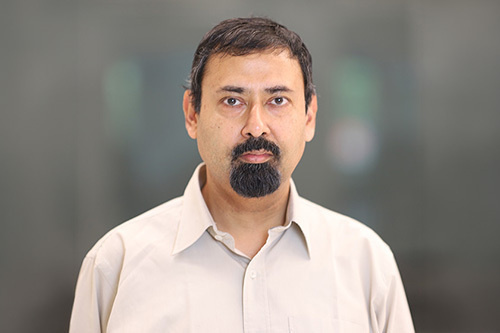
Bio: Amit Sanyal obtained the B.Tech. degree in aerospace engineering from the Indian Institute of Technology, Kanpur, in 1999. He completed his M.S. in aerospace engineering from Texas A& M University in 2001, where he received the Distinguished Graduate Student Masters Research Award. He obtained his Ph.D. in aerospace engineering and M.S. in mathematics from the University of Michigan in 2004 and 2005 respectively and was recipient of an Engineering Academic Scholar Certificate. After his post-doctoral research at Arizona State University in 2005-2006, he joined the faculty in mechanical engineering at the University of Hawaii in 2007. He has been a faculty in mechanical and aerospace engineering at New Mexico State University (2010-2015) and is currently a faculty in mechanical and aerospace engineering at Syracuse University. He develops and applies techniques from geometric mechanics, nonlinear and geometric control, and continuous and discrete-time Lagrangian/Hamiltonian systems to dynamics modeling, guidance, navigation, and control of unmanned and autonomous systems. He is an associate fellow of AIAA, a senior member of IEEE, and a member of ASME and SIAM. His research has been supported by NSF, NASA, and AFOSR, and he co-founded Akrobotix LLC, an aerospace start-up company.