Recovering Molecular Heterogeneity using Molecular Simulation, Electron Microscopy, and Machine Learning
Many of the chemical systems most relevant to modern science and technology — proteins, doped semiconductors, and catalysts – are structurally heterogeneous at scales of nanometers or smaller. Understanding this heterogeneity is crucial to understanding the link between their design and their function. Molecular simulation and machine learning tools have the ability to visualize this heterogeneity with incredible specificity, but are inherently limited by model biases. Experimental techniques, such as electron microscopy, have the opposite approache – they can image heterogeneity in real samples, but must contend with low signal-to-noise ratio and ambiguity in the imaging process. Consequently, there is a need for approaches that directly combine these techniques. In this talk, I review our recent progress towards developing new algorithms that integrate computational tools with electron microscopy data. We initially focus on biomolecular electron microscopy, where we introduce algorithms that integrate electron microscopy with molecular dynamics, as well as structure prediction tools such as Alphafold3-like models. On test systems, our algorithms are able to recover states that are missing from the model, improving heterogeneous prediction. We then discuss our initial work transferring these ideas to electron microscopy of materials.
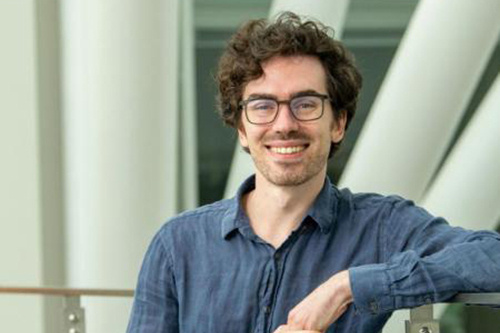
Bio: Erik is an assistant professor in the Department of Chemistry and Chemical Biology at Cornell University. His focus is theoretical and computational chemistry, which means that theoretically he knows something about both chemistry and computers. After receiving his undergraduate degree in sunny North Carolina, Erik pursued a Ph.D. at the University of Chicago with Professors Aaron Dinner and Jonathan Weare working on the intersection of molecular simulation and applied math. He then took a postdoctoral position at the Flatiron Institute in the Center for Computational Mathematics.