Computation of Hypersonic Flow and its Effects on Materials, Structures, and Trajectories
The development of hypersonic vehicles is of broad international interest today for applications in national security, deep space exploration, and the emerging space economy. While the first hypersonic vehicle flew more than 70 years ago, their effective design still faces major technical challenges. The overarching cause of this difficulty stems from the fact that many key individual physical processes relevant to hypersonic flight are tightly coupled. The gas dynamics of the air flow around the vehicle creates temperatures of thousands of degrees leading to internal energy excitation and chemical reactions. The hot, oxidized gas in contact with the surfaces of the vehicle leads to material response phenomena such as conduction, radiation, and ablation. The thermally soaked material alters the structural response to the aerodynamic loading. Changes in the vehicle outer mold line due to ablation and structural deformation change the basic aerodynamic performance and thus affect the flight dynamics. With advanced numerical algorithms and modern computer architectures, it is becoming possible to include many of these complex processes in hypersonic vehicle analyses. This talk will review the current status for computational modeling of each separate discipline as well as efforts to couple these processes together. Key aspects for coupling include consideration of timescales associated with different processes and multi-fidelity simulation approaches.
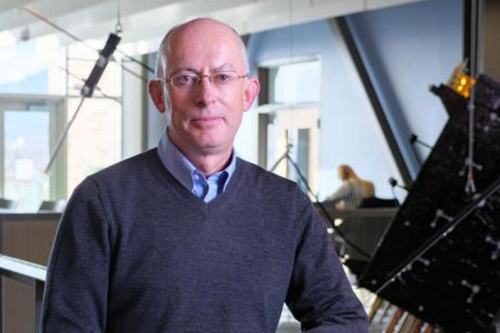
Bio: Iain D. Boyd is the H. T. Sears Memorial Professor of Aerospace Engineering Sciences at the University of Colorado Boulder where he also serves as the Director of the Center for National Security Initiatives. He received a Ph. D. in aeronautics and astronautics (1989) from the University of Southampton in England. His research interests involve the development and application of physical models and computational methods for analysis of nonequilibrium gas and plasma dynamics processes in aerospace systems. He has authored over 250 journal articles, more than 400 conference papers, and published a book entitled “Nonequilibrium Gas Dynamics and Molecular Simulation.” Boyd is a Fellow of the American Institute for Aeronautics & Astronautics (AIAA), the American Physical Society, and the Royal Aeronautical Society. He has received the AIAA Lawrence Sperry Award and the AIAA Thermophysics Award. Boyd is the Director of a NASA-funded Space Technology Research Institute on hypersonic entry systems and leads a major Department of Defense project on hypersonic plasma formation.