From Proofs to PDEs: Unlocking Scientific Agents Through Generative Verification
AI agents are most effective when answers are difficult to find but cheap to verify. This asymmetry has accelerated theorem proving and code generation, but it breaks down in computational science: assessing an agent-designed discretization, reduced-order model, or learned PDE solver may require an expensive high-fidelity trajectory — the computation the proposed method was meant to avoid. This motivates a central question: can computational sciences recover this verifier advantage?
Our answer is generative verification. Numerical methods-especially reduced-order models-are designed for particular operating regimes, traditionally specified through physical intuition about the solution structures that matter. With sufficient data, a generative model can instead learn this regime as a distribution over plausible solutions. Samples serve as hidden manufactured solutions: the governing equations are used to derive the corresponding forcing, initial conditions, and boundary conditions exposed to the agent, while preserving exact private reference solutions for automatic scoring. We use this reusable verifier in an iterative loop that targets the current solver’s failures without drifting from the target regime. Across Navier–Stokes and Vlasov-Poisson equations, verifier-guided iteration improves the accuracy and robustness of agent-designed numerical solvers and reduced-order models on unseen cases. Generative verification thus turns learned regime knowledge into scalable feedback, bringing verifier-driven scaling from proofs and code to computational science. Joint work with Muheng Li.
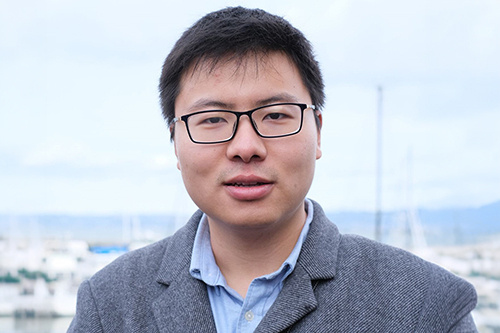
Bio: Wenlong Mou is an assistant professor in the Department of Statistical Sciences at the University of Toronto. He received his Ph.D. in electrical engineering and computer sciences from UC Berkeley in 2023. Before joining Berkeley, he earned a B.Sc. in computer science and a B.A. in economics from Peking University.
His research explores the interplay between AI and dynamics, spanning AI for scientific and engineering problems in physical systems and the dynamics of learning algorithms. On the scientific side, he develops AI agents and machine learning methods for scientific computing and control. His work on theoretical foundations includes reinforcement learning with function approximation and post-training optimization of modern generative models. His work has been published in leading journals and conferences in machine learning, statistics, and applied mathematics, and was recognized as a finalist in the INFORMS Applied Probability Society Best Student Paper Competition.