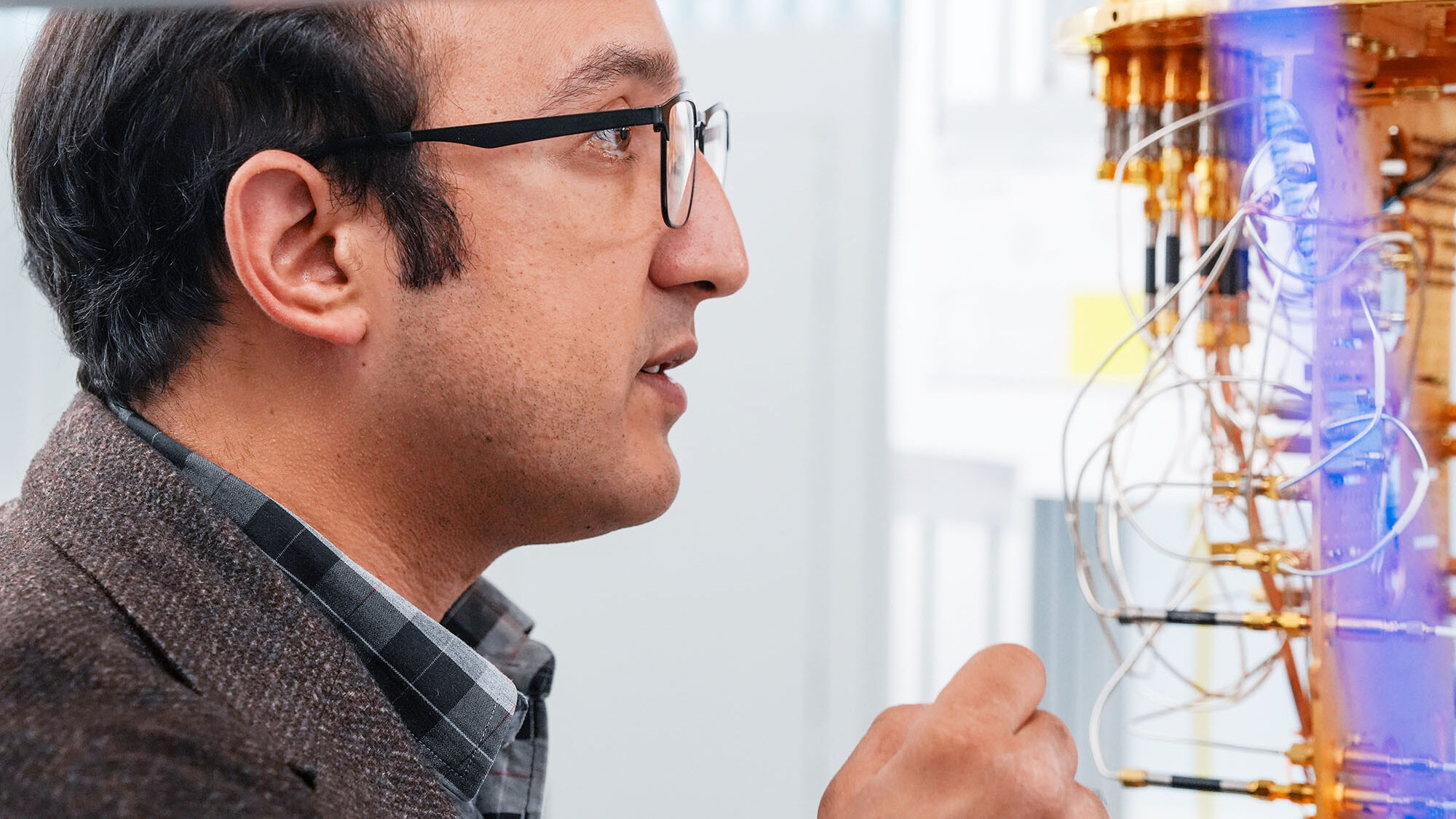
Quantum technology has been described as revolutionary or transformative, and Valla Fatemi, assistant professor in the School of Applied and Engineering Physics at Cornell, is at the leading edge. His lab works on projects that range from developing new materials for quantum information processing to discovering new quantum phenomena. But what does his work actually entail?
Fatemi’s research group focuses on quantum bits, or “qubits,” which are the physical building blocks of much of quantum information technology. Drawing an analogy to the early days of digital information technology, Fatemi describes qubits for quantum technology as being comparable to transistors for digital information technology in terms of their basic importance. Qubits of varying kinds may one day power quantum sensors and quantum communication systems.
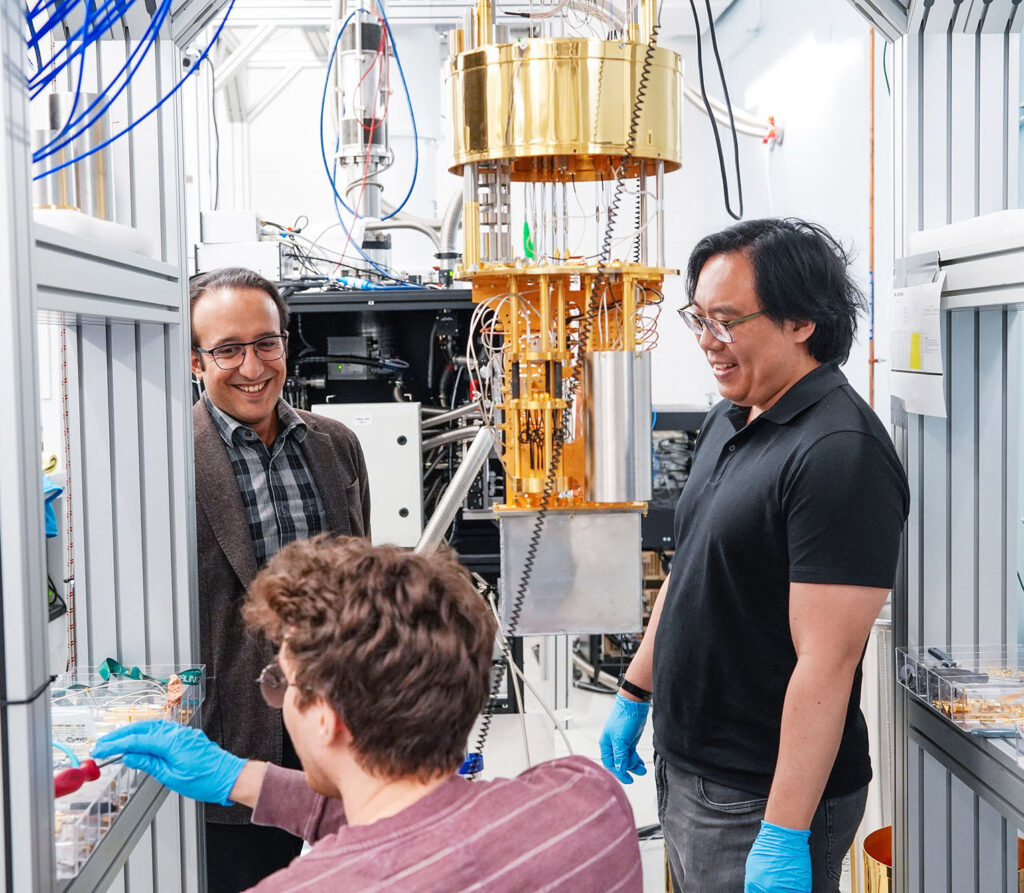
Fatemi’s lab works on conceiving new kinds of qubits and demonstrating that they are superior to existing designs. He views his lab as being a “an invention-oriented space” for new qubits. The lab focuses on quantum devices in the solid state, fabricating superconducting nanostructures using nanotechnology in cleanroom facilities such as the Cornell Nanoscale Facility, and performing measurements using sophisticated microwave electronics.
“Using an analogy to electrification, quantum technology can be viewed as being in an era similar to that of Edison and Tesla,” said Fatemi. “We understand the basic principles, but we are still figuring out which specific materials to use and how to engineer them properly to build progressively better devices and larger systems. If you think of current qubits as equivalent to an early incandescent lightbulb, our long-term goal is to make the leap to an LED.”
“There’s another part,” he continued. “We also need to show that the newest types of devices can be better than what we already have. The newest concepts for qubits are not as well understood by the broader community, so we must demonstrate that they perform well.”
The lab’s research so far falls into three main areas. First, the group develops materials and nanofabrication methods for established types of qubits and investigates when and why certain materials perform well or poorly in existing designs. The goal of this area of research is to understand the relevant basic material science and translate that knowhow into improved qubits. In this direction, their lab has recently posted a preprint demonstrating some of the best-performing superconducting qubits in the world. Furthermore, new materials can make it possible to alleviate the operational environmental requirements for creating superconducting qubits which currently require extremely cold temperatures – 1% of a degree above absolute zero. Fatemi notes that even modestly raising the maximum operating temperature can relax the engineering requirements considerably.
The lab’s second area of focus is the creation of conceptually new types of qubits. His lab is currently exploring a novel qubit that merges spintronics and superconductivity. As a postdoctoral associate at Yale, Fatemi developed a device containing a single electronic spin, analogous to a magnet, where the spin direction dictates the direction of current flow. His group at the Cornell Duffield College of Engineering is developing theoretical and experimental approaches to building devices based on this qubit concept that may become technologically competitive.
A third research direction focuses on qubit control. Manipulating quantum information is complicated, and Fatemi’s group is developing better ways to control and read out qubit states based on resonators. Specifically, his lab works out new methods of shaping electrical signals to control qubits or multi-qubit systems into accomplishing desired logical operations.

The National Institute of Standards and Technology has called for the exact kinds of advances Fatemi and his lab are striving for. Their March 2026 statement on the importance of quantum computing said, “If quantum computers eventually become large and powerful enough, scientists hope that … quantum simulations could bring about major advances in materials science, drug development and other areas. Potentially transformative ‘killer apps’ for quantum simulation could involve discovering a new blockbuster drug or chemical catalysts that make the production of fertilizer or the capture of greenhouse gases from the air more efficient.”
Fatemi is currently supervising six graduate students and two postdoctoral researchers. Together, they are working to revolutionize quantum science and develop technologies that may one day impact society on a global scale.