Sophia Ayeni, M.Eng. ’25 developed a fish-skin biomaterial for neurosurgical training through independent research, mentorship and coursework, culminating in a presentation at the 2026 IEEE Engineering in Medicine and Biology Conference.

Sophia Ayeni
-
Program
M.Eng. in biomedical engineering
-
Preferred Pronouns
she/her
Sophia Ayeni entered Cornell’s Meinig School of Biomedical Engineering Master of Engineering (M.Eng.) program with an idea for using fish skin as a biomaterial for a synthetic alternative to burn bandages. Through coursework, mentorship and independent research, that idea evolved into a project addressing an entirely different challenge: developing an accessible training material for neurosurgery.
A key step in that evolution came when Sophia volunteered as a student mentor in a summer program led by Associate Teaching Professor Suélia Fleury Rosa. Working with high school student Imri Wolf on a biomedical application project gave Sophia an opportunity to engage with research beyond the classroom and learn more closely from Rosa.
That experience led Sophia to BME 5930: Independent Design, where she developed a research project under Rosa’s supervision. Her initial interest in fish skin became an investigation of whether collagen extracted from tilapia skin could be combined with natural latex to create a low-cost training membrane with mechanical properties similar to human dura mater.
The resulting project, “Biomedical Engineering for Society: A Collagen-Latex Composite from Fish-Skin for Equitable Neurosurgical Training,” evaluated a 70:30 fish-collagen and latex composite as a potential training material for settings where access to cadaveric specimens is limited. Preliminary testing found the material’s thickness and elastic modulus within documented ranges for native dura mater, while both samples withstood 18-gauge needle penetration without tearing or leakage.
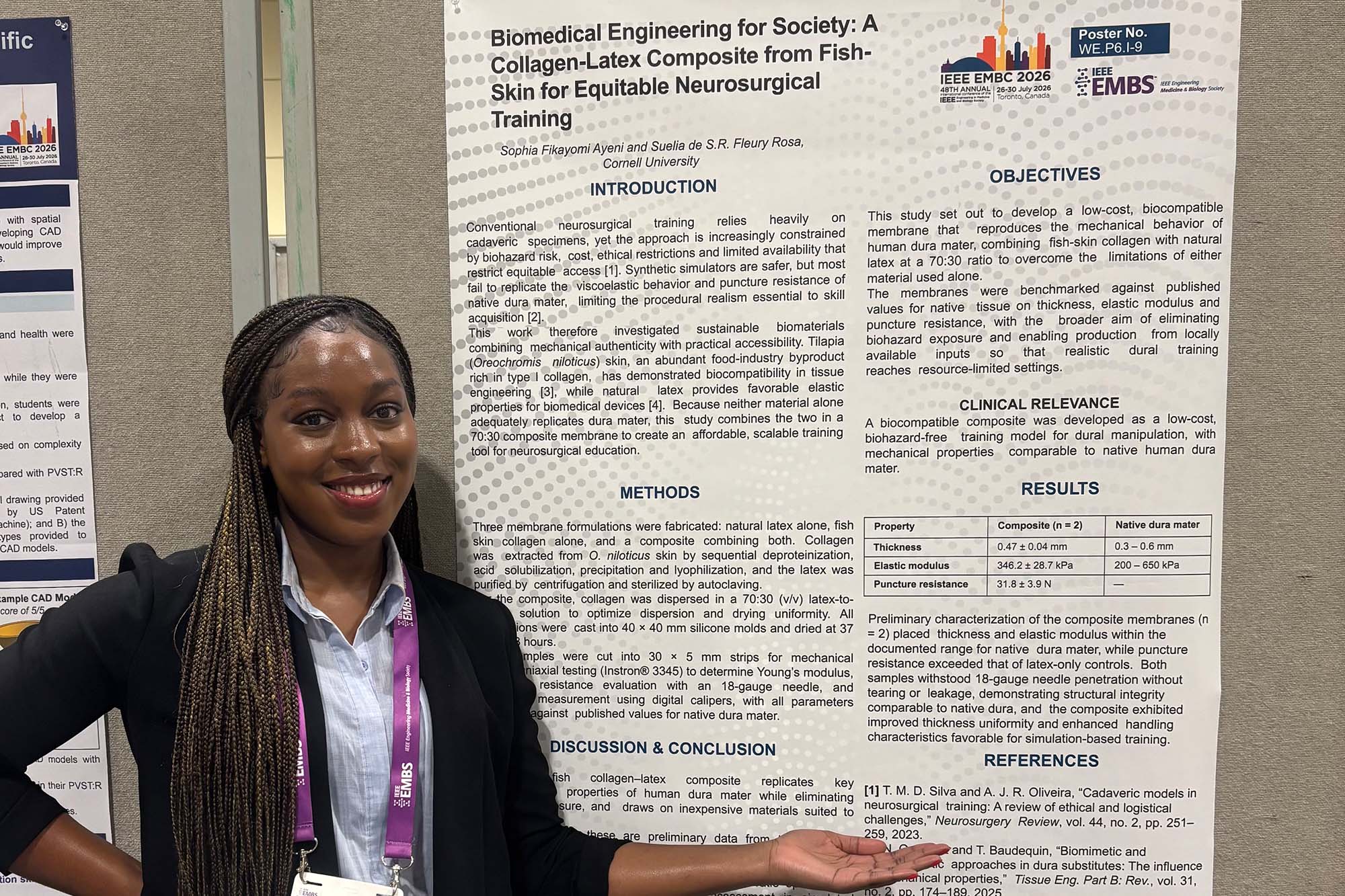
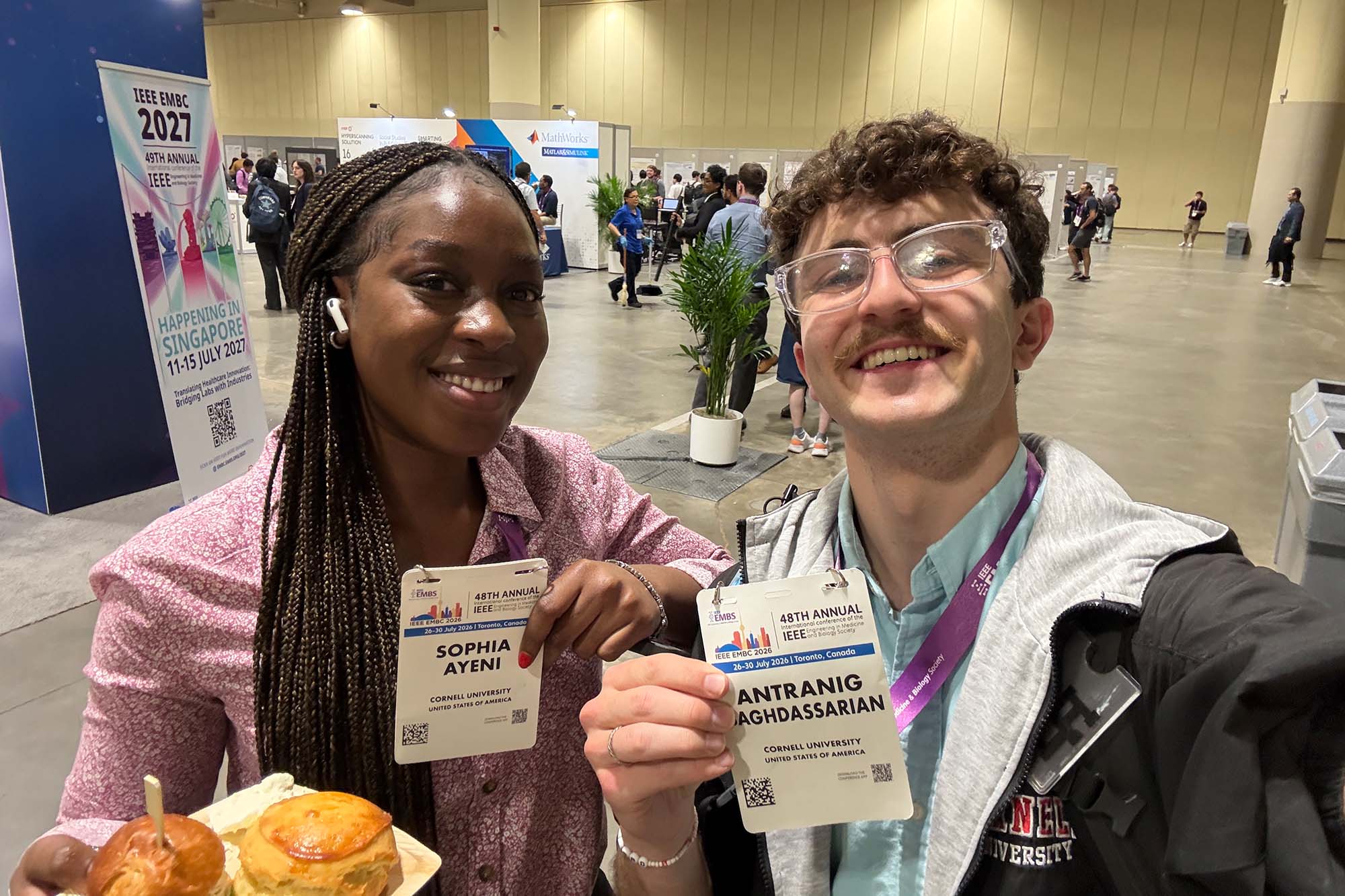

In July 2026, Sophia presented the resulting research at the 48th Annual IEEE Engineering in Medicine and Biology Conference (EMBC) in Toronto, where she connected with researchers and students from around the world. She also explored research in brain-computer interfaces, robotics and real-time electromyography, and joined the IEEE Women in Engineering/Biomedical Engineering network.
The experience expanded Sophia’s understanding of what biomedical engineering research can address, particularly the role of engineering design in addressing inequities in biomedical technology.
“Presenting at EMBC was an exciting milestone in my M.Eng. experience,” said Ayeni. “But perhaps the most valuable part was seeing how much an initial idea can develop when given the right mentorship, coursework, and opportunity to explore.”
She credits BME 5500: Innovation and Design of Biomedical Technologies, taught by Newton de Faria, director of the M.Eng. program and professor of practice, with emphasizing innovation in biomedical engineering along with the independent design project course with giving her the opportunity to apply that mindset through independent research. Rosa helped guide the project from its early development through its presentation at EMBC.
Sophia’s experience shows how an M.Eng. student can enter the program with an initial interest, encounter new possibilities and develop that interest into independent work with a broader impact.