When Jason Erdell ’95 returned to the Cornell Duffield College of Engineering last fall, he came not simply to talk about artificial intelligence, but to reflect on how an operations research mindset prepares engineers to navigate repeated waves of technological change.
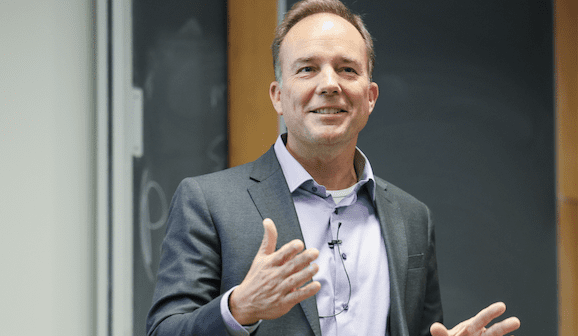
Erdell, chairman and CEO of MDpanel, delivered the October 2025 lecture as part of the Mei-Wei ’72 and Amy Cheng Distinguished Lecture Series, which brings accomplished alumni back to campus to engage students on leadership, innovation and professional life.
Drawing on three decades of experience spanning Silicon Valley, management consulting, private equity and health care technology, Erdell framed Operations Research and Information Engineering not as a narrow discipline, but as a durable way of thinking about complex systems under uncertainty.
That perspective was shaped early. Erdell grew up in Brookfield, Wisconsin, outside Milwaukee, raised by a single mother alongside his brother. From a young age, he gravitated toward logic-driven disciplines, describing himself as a strongly left-brained thinker who was fascinated by science, math and finance. He recalled watching business news in the mornings and reading about emerging scientific ideas well before college, driven by a desire to understand how large systems – from markets to the universe itself – work.
That inclination led him naturally to engineering, and more specifically to what was then industrial engineering, now operations research and information engineering. Erdell said he was drawn to the academic discipline because it combined engineering rigor with business and process thinking, offering a bridge between analytical tools and real-world decision making. Cornell’s breadth also played a decisive role. He said he wanted an education that would supplement his analytical strengths with exposure to other ways of thinking, and Cornell’s cross-disciplinary environment offered that balance.
While Erdell valued the school’s technical foundation, many of the courses that left the strongest impression on him were outside engineering, including classes in business law and astronomy. Those experiences expanded how he thought about uncertainty, risk and human behavior, concepts that would later shape his leadership approach. Within operations research, courses in optimization and simulation were particularly formative. Erdell recalled the school’s transition toward simulation-based methods, a shift he now sees as an early parallel to the rise of AI.
Rather than forcing analytical solutions on problems that resist them, simulation allows engineers to explore how systems behave by running many trials and observing outcomes. Erdell sees that mindset – letting computation reveal insight – as central to modern AI and machine learning, and as a throughline connecting operations research training to today’s most powerful technologies.
After graduating in 1995, Erdell moved to California to work at Hewlett-Packard, gaining hands-on industry experience before pursuing an MBA at Northwestern University’s Kellogg School of Management. He has said that working before returning to school made graduate study far more valuable, giving him real-world context for theory and reinforcing the importance of practical exposure for engineers considering advanced degrees.
At Kellogg, Erdell deliberately focused on areas where he felt least prepared, particularly marketing and sales, while continuing to deepen his strengths in finance and decision science. Even there, he found himself gravitating toward quantitative coursework, a reflection of the operations research mindset that continued to shape how he approached problems and opportunities.
From Kellogg, Erdell entered management consulting at Booz Allen Hamilton. Consulting appealed to him because it offered early exposure to executive-level challenges and complex organizational systems, an environment well suited to operations research-trained problem solvers. Over time, however, he found the lack of ownership difficult, noting that while consulting provides intellectual stimulation, it separates strategy from execution. That realization eventually pushed him to seek roles where he could directly influence outcomes.
That desire led to an unexpected pivot into retail, where Erdell joined Gap Inc. and worked across Banana Republic and other brands. Tasked with redesigning product development processes, he applied operations research principles such as process design and reliability in a setting driven by creativity rather than analytics. The experience forced him to develop a deeper appreciation for empathy and human dynamics, skills he now considers essential to effective leadership.
Over time, Erdell came to see empathy as the single most important quality he looks for when hiring. Technical skills matter, he said, but without empathy, even highly capable people can undermine teams and decision-making.
A candid conversation with a mentor at Gap ultimately clarified that Erdell had reached the limits of what that environment could offer him. The moment prompted another reassessment – one rooted in operations research-style thinking about constraints, leverage and long-term opportunity – and led him into private equity and, eventually, health care.
Health care, Erdell has noted, represents nearly 20 percent of the U.S. economy and is among the most complex systems engineers can encounter. That complexity makes it resistant to simple fixes, but also rich with opportunity for those who understand how systems evolve.
Today, as chairman and CEO of MDpanel, Erdell leads a company that uses AI, machine learning and data science to modernize medical opinion services for insurers and health care organizations. His earlier role as CEO of Aspirion followed a similar pattern, applying analytics to improve reimbursement operations.
That philosophy shaped his 2025 Cheng lecture, which opened with a reflection on the pace and scale of AI-driven change. Erdell told students that the productivity gains from AI are already enormous and compared the current moment to the early days of the internet, arguing that the implications may be even greater.
“There could come a point where the idea of a traditional job doesn’t exist anymore,” Erdell said. “So what differentiates us as humans? Adaptability, creativity and continuous learning.”
To organize those ideas, Erdell structured his talk around three “bubbles”: comfort, competency and innovation. He encouraged students to expand their comfort zones by embracing unfamiliar roles, to build broad competencies rather than narrow expertise, and to look for innovation in overlooked systems rather than headline-grabbing technologies.
Throughout the lecture and discussion with students, Erdell returned to Cornell’s rigor as a defining influence. The challenge of the operations research curriculum, he said, builds confidence that difficult problems can be worked through, a trait he still values when evaluating engineers.
As the talk concluded, Erdell left students with a principle his company borrows from the Mayo Clinic: “Think big, start small, move fast.” Focus on meaningful problems, he explained, but begin with the smallest viable step and iterate quickly.