Nikita Doikov has joined Cornell Engineering’s School of Operations Research and Information Engineering as an assistant professor, bringing with him a deep interest in the theoretical foundations of optimization and a curiosity about how those foundations shape modern artificial intelligence. His work focuses on designing and understanding optimization algorithms that lie at the core of machine learning systems and large-scale AI models.
“Training an AI system is, at its heart, an optimization problem,” Doikov said. “If we understand these algorithms better and if we can make them more efficient, we can significantly reduce the resources required to train modern models.”
Doikov was born in Vladivostok, a coastal city in Russia’s Far East, situated along the Sea of Japan. Surrounded by dramatic landscapes and abundant wildlife, the city left a lasting impression. “It’s a very beautiful place,” he said. “There’s a lot of nature, and animals like tigers and bears live surprisingly close to people.”
As a child, Doikov developed an early curiosity about how things work—especially computers. His father, an engineer, helped spark that interest. “He taught me how radios work and explained basic physics,” Doikov said. The family computer, which belonged to his older brother, became another gateway. “I remember my brother coming home from high school and showing me a piece of code he had just learned,” he said. “I hadn’t even started school yet, but I was fascinated.”
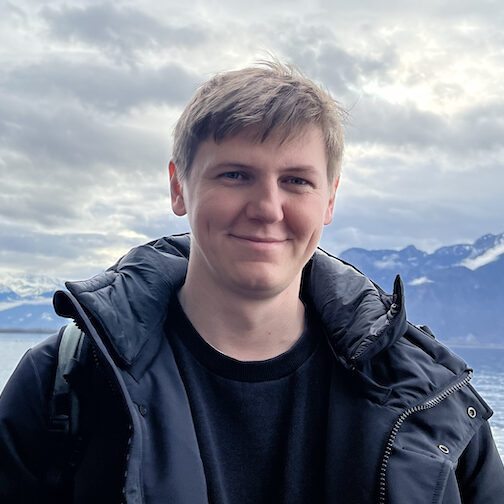
By his early teens, Doikov was experimenting with programming, writing small pieces of code and simple games. He also went to music school and played both flute and piano, inspired by his mother, who is a piano teacher. “I had many interests,” he said. “But computers were always one of the main ones.”
Doikov left Vladivostok to attend Moscow State University, where he studied at the Faculty of Computational Mathematics and Cybernetics—a program that blends computer science and mathematics. “I usually just call it applied mathematics,” he said. “It has a strong focus on core mathematics, but always with the idea that it should be used in practice.”
As an undergraduate, Doikov participated in programming competitions, an experience he credits with sharpening his algorithmic thinking. “Sometimes you have to invent your own solution to a problem,” he said. “That’s a bit like research.” Around the same time, he began working with faculty advisors on early research projects and gravitated toward machine learning—a field that was still emerging.
Approaching graduation, Doikov faced a familiar crossroads: industry or academia? He explored both paths, working as a software engineer while continuing his studies and completing internships at Google in Zurich. “I wanted to understand what industry looks like,” he said. “After that experience, I was even more convinced that I wanted to continue doing research.”
He pursued his Ph.D. in Belgium at Université Catholique de Louvain, where he worked under the supervision of Yurii Nesterov, a leading expert in optimization algorithms. “I was very fortunate to have him as an advisor,” Doikov said. “He taught me not only how to do research, but also how to grow as a scientist.”
After earning his doctorate, Doikov joined EPFL (the Swiss Federal Technology Institute) in Lausanne, Switzerland, as a postdoctoral researcher, working in the Machine Learning and Optimization Laboratory. There, he expanded his research perspective by collaborating with applied researchers and mentoring graduate students.
At Cornell, Doikov plans to continue advancing the theory of continuous optimization while engaging directly with questions raised by modern AI systems. His group will focus on designing algorithms with provable convergence guarantees and studying the geometry of optimization landscapes underlying large models.
In Spring 2026, Doikov is teaching a graduate course on continuous optimization, a subject closely aligned with his research. Outside of research, he recently began learning how to sail and looks forward to exploring the Finger Lakes after arriving in Ithaca.