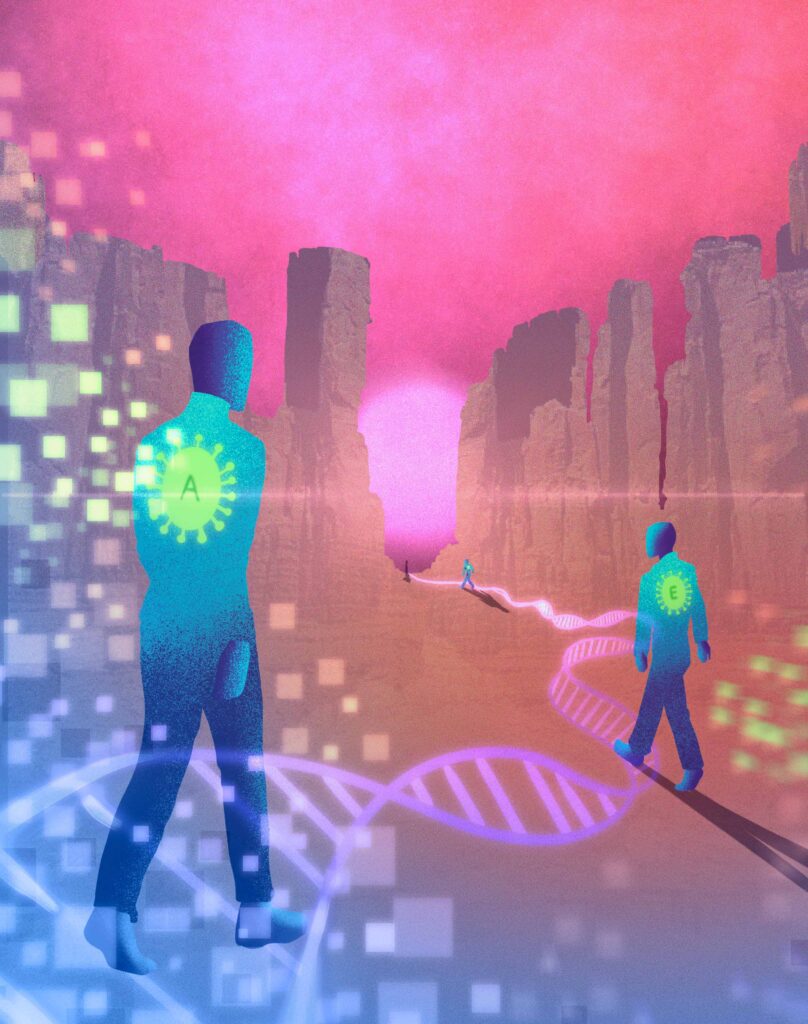
Evolution is often viewed as something scientists observe. Pablo Cárdenas Ramírez wants engineers to make evolutionary change part of the design process.
As assistant professor in Cornell’s R.F. Smith School of Chemical and Biomolecular Engineering, Cárdenas Ramírez leads the Multiscale Evolutionary Engineering Lab, where researchers are developing an evolutionary toolbox to better understand, predict and guide how biological systems change. By combining synthetic biology, computational modeling and machine learning, the lab studies evolution across scales, from individual molecules to entire populations, with the objective of creating therapies and technologies that remain effective as cells and pathogens adapt.
“Our goal is to make a quantitative and predictive engineering discipline based on evolution,” Cárdenas Ramírez says. “If we can understand where evolution might go and how likely it is to get there, we can design therapies and technologies that remain effective for longer.”
The lab’s research has applications spanning medicine, agriculture and biotechnology, including developing strategies to improve treatments for infectious diseases and cancer, engineer healthier microbiomes, and create more sustainable biological manufacturing systems. By combining experimental models with predictive computational tools, the group works to quantify uncertainty in evolutionary forecasts, helping scientists, engineers and policymakers make better decisions when designing biological systems.
Originally from Bogotá, Colombia, Cárdenas Ramírez earned his undergraduate degree at Universidad de los Andes. He completed his Ph.D. in biological engineering at the Massachusetts Institute of Technology, where he developed molecular and computational approaches to study malaria parasites and pathogen evolution. As a postdoctoral fellow at Harvard Medical School, he expanded his research into protein engineering, immunology and virology, experiences that solidified his collaborative and interdisciplinary approach to science.
Cárdenas Ramírez champions dedicated mentorship and open science as core values in research. He believes sharing data, code and methods accelerates discovery, strengthens the connection between research and the public it serves, and prepares students to tackle complex challenges. At Cornell, he is using these approaches to advance a vision of evolution not just as a force that shapes life, but as a tool engineers can harness for innovation.
Outside the lab, Cárdenas Ramírez is drawn to the ways ideas and cultures evolve over time. He enjoys reading and learning about history, finding parallels between the evolution of human culture and the biological systems he studies. He is also an avid music listener and enjoys playing a variety of instruments.