Growing up in a small village in central China, where his family’s home sat halfway up a mountainside, Tingan Li spent much of his childhood outdoors. The landscape surrounding his home was both a refuge and a classroom, shaping a lifelong curiosity about the forces that sculpt rivers, hillsides and mountains.
Today, that curiosity has brought Li to Cornell as an assistant professor in the Department of Earth and Atmospheric Sciences, where he studies the physical processes that shape Earth’s surface—from the movement of sediment in rivers to the hidden flow of water beneath glaciers. His research combines field observations, laboratory experiments and mechanistic computer models to better understand how landscapes evolve over time.
“I spent a lot of time in nature when I was a kid,” Li said. “When I went back and asked myself what I was actually interested in, I realized it was rivers and mountains and how these things work together.”
That realization was not immediate.
As the first generation in his family to attend college, Li initially pursued petroleum geology because it promised stable employment. Having grown up in his village, he understood why his parents encouraged a practical career path, even if it wasn’t where his own interests ultimately lay.
“In their mindset, the reason you go to college is to find a job that makes money,” he said. “But I realized I wanted to study what I was really interested in.”
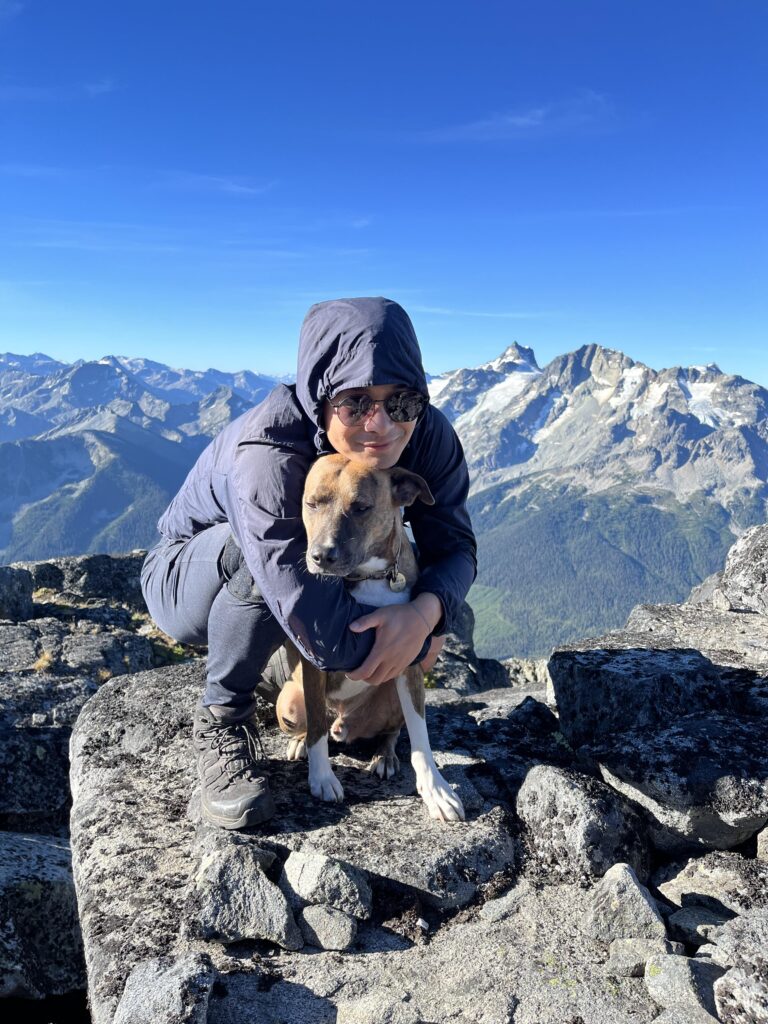
He found that opportunity while pursuing a Ph.D. in geomorphology at Simon Fraser University in Vancouver, British Columbia. Surrounded once again by mountains and rivers, Li shifted his focus from energy resources to understanding how landscapes form and change. After completing his doctorate in 2022, Li remained at Simon Fraser for a postdoctoral fellowship. His time there provided a strong foundation for doing science by teaching him how to conduct rigorous research and write scientific papers.
He then moved to the California Institute of Technology (Caltech) for a second postdoctoral appointment. Caltech exposed him to some of the world’s leading Earth scientists and helped clarify what kind of researcher—and mentor—he wanted to become.
“I learned from scientists there how to think about the big questions,” Li said. And experiencing different advisory styles throughout his early career, ranging from hands-off freedom to frequent check-ins, also taught him that effective mentoring isn’t one-size-fits-all.
Many geomorphologists have traditionally viewed water as the primary force responsible for shaping landscapes. Li’s research argues that sediment often plays an equally important—sometimes dominant—role.
“My work is trying to understand the mechanisms rather than just the correlation,” he said. “Sometimes we get the right answer, but for the wrong reasons. I want to understand the physics that actually produce the landscapes we see.”
His research group at Cornell is off to a fast start. Li arrived on campus with funding for research on subglacial hydrology, supporting one doctoral student who will investigate how water and sediment move beneath glaciers using laboratory flume experiments. At the same time, another doctoral student will examine how sediment influences the long-term evolution of mountain landscapes.
Those projects reflect another aspect of Li’s approach: he wants his students to help shape the questions his group pursues.
“I want to ask them what they’re most interested in,” he said. “We’ll find common ground between what I’m curious about and what they want to discover.”
That same collaborative spirit influenced his decision to join Cornell.
After interviewing with the Department of Earth and Atmospheric Sciences, Li was struck by the department’s supportive culture. Cornell felt like a place where faculty members genuinely enjoy working together and pursuing questions driven by curiosity. Ithaca itself also reminded him of home.
“I really like the vibe of the department,” he said. “People are friendly. They like to work together. They focus on what they enjoy doing. And I grew up in a small village, so I really enjoy the small-town feeling here.”
Outside the lab, Li is an avid rock climber, regularly climbing indoors during the week and traveling on weekends to climbing destinations throughout the Northeast. His passion for climbing even sparks new research ideas. Recently, he began exploring whether rain-weakened sandstone at climbing areas could provide insights into the physical processes that govern rock weathering and erosion.
This fall, Li is teaching a new course, Surface Processes and Landforms, designed for both undergraduate and graduate students. Rather than limiting instruction to the classroom, he plans to use Ithaca’s gorges, waterfalls, and glacial landscapes as living laboratories.
“When you go hiking or even just walking around Ithaca, there are so many questions you can ask,” he said. “Why are the gorges here? How were they formed? Why are there so many potholes in Ithaca? Surface processes can help explain all of these things. I want students to connect the theory to the landscape they’re seeing every day.”
For Li, that connection between everyday observation and scientific discovery is the same one that first took root decades ago, while wandering the mountains surrounding his childhood home. The questions have become more sophisticated, but his sense of wonder remains the same.