When Sofia Pereira graduated from Cornell in 2023 with a B.A. in physics, she wasn’t certain what would come next. Many of her classmates entered Ph.D. degree programs immediately after graduation, “which made perfect sense for them,” she said, “but I needed more time to explore how I wanted to use my physics degree.”
In her first position following graduation she worked as a mechanical engineer at Bimotal Inc., a Berkeley-based startup developing compact electric powertrains for applications like e-bikes and gurneys. Although it was a significant change from the fundamental physics that she studied at Cornell, she discovered that she loved the hands-on, iterative design process of mechanical design: working within constraints, refining systems, and thinking through how parts behave in the real world. Over time, she realized she wanted to bring that same design mindset to a scientific context.
“When you design for production scales, everything has to be fail-proof,” she said. “It turns out all the things that can make your design fail are themselves interesting, and this led me back to wanting to learn more about the mechanisms that determine how materials behave at the atomic scale.” So in the fall of 2025, Pereira returned to Cornell as an engineering physics M.Eng. student.
“After graduating, I went from one extreme to the other—from an undergraduate degree in pure physics to a job that focused heavily on production,” she said. “I’ve now landed at the intersection of my passion for mechanical design with hands-on applications and the deep physics aspect of what’s going on ‘under the hood.’ I like that my M.Eng. program is flexible and allows me to do a lot of mechanical design and learn all about circuit board design and material science, while at the same time pursuing applied physics classes. It’s been very exciting.”
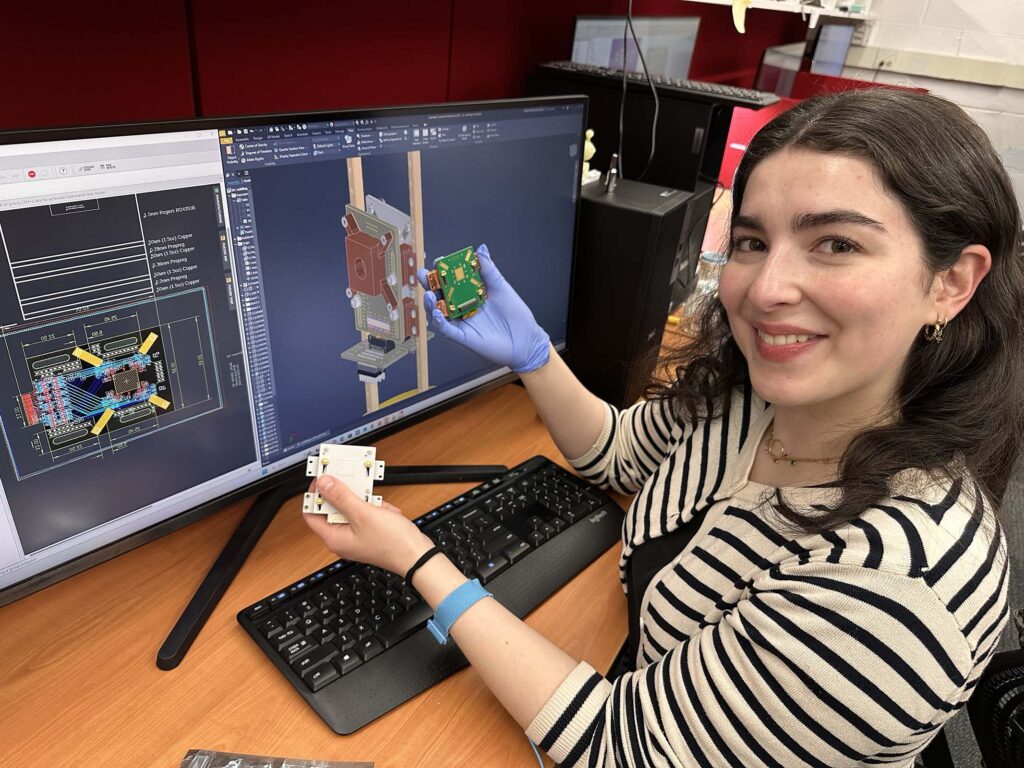
Pereira works in professor Valla Fatemi’s lab, which actively researches superconducting qubits, quantum information, and how these devices can be made more robust and stable. Since joining the group, she has contributed to the design of instrumentation needed to analyze and test new quantum devices at room temperature and ultra-low (dilution) temperature.
Part of her work involves combining mechanical design and circuit-board design to test Josephson junctions—precise, nanometer-sized structures that sandwich a thin insulating layer between two superconducting films. These structures are a crucial circuit element used in the fabrication of superconducting qubits. When incorporated into a qubit, they affect the spacing between the circuit’s discrete energy levels, enabling quantum information to be encoded and read out.
“Through my work as a mechanical engineer, I started to ask whether the kinds of questions I dealt with in mechanical design are still relevant when you zoom all the way down to the nanoscale. It turns out that at very small scales the underlying physics become dominant.”
For students considering a M.Eng. in engineering physics, Sofia sees the program as an ideal opportunity to explore and deepen interests across diverse disciplines. In the future, Sofia is considering pursuing either a Ph.D. in a materials-related area or continuing in research and development of instrumentation roles in industry. Either way, she plans to stay at the intersection of hands-on engineering and fundamental physics.