On a remote island off the coast of Puerto Rico, an experimental network of solar panels, batteries and hydrogen storage could prove to be the future of resilient energy for isolated communities.
As part of the project, “Hybrid Storage Electrification Strategies for Isolated Communities,” Alex Van Den Hende ’25, M.Eng. ’25, is working on a renewable microgrid project in Vieques, a small island off the coast of Puerto Rico that has a population of just over 8,100 and struggles to supply consistent electricity to its residents. Vieques receives most of its energy from the mainland through an underwater cable, but frequent hurricanes and poor maintenance of aging power-generation systems have resulted in an unreliable grid in Vieques. Blackouts are frequent and unexpected, and energy prices are extremely high.
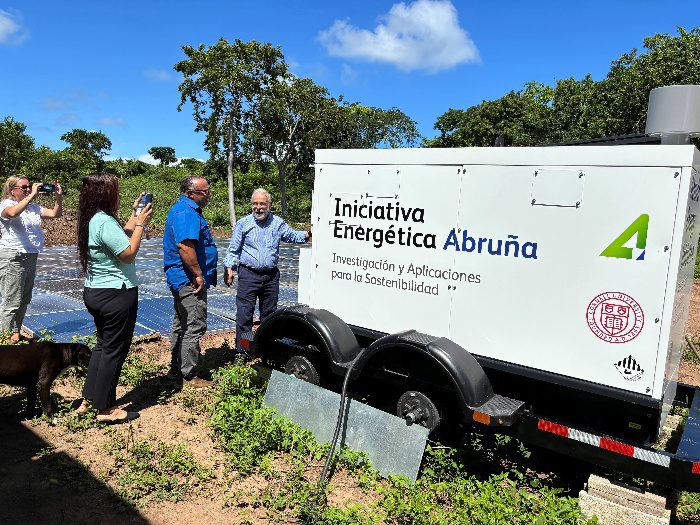
Van Den Hende said that in 2017, hurricane Maria left Vieques without power for more than 12 months and destroyed the island’s only hospital. To counteract unexpected outages caused by hurricanes, extreme weather and limited availability of imported energy, being able to store energy for days or weeks is essential to the island.
“For my project, my team focused on combining short-term battery storage with long-term green hydrogen storage,” Van Den Hende said. “My work described the optimal way to combine these systems for implementation in Puerto Rico and other regions.”
That team includes Héctor Abruña, the Emile M. Chamot Professor in the College of Arts and Sciences, whose research focuses on the development and characterization of new materials for fuel cells, batteries and molecular electronics, including through several real-world projects within the Abruña Energy Initiative.
Van Den Hende was introduced to the initiative through his M.Eng. program in the School of Applied and Engineering Physics, which, he said, allowed him to build on his environmental engineering background and deepen his passion for renewable energy.
“Environmental engineering helped me understand a grid energy system and how to implement renewables from a policy standpoint,” Van Den Hende said, “That was really powerful, but I didn’t understand the physics of it. How does a battery function? How do photovoltaics work?”
His interests led him to pursue an early-admit M.Eng. degree in applied and engineering physics, where he was able to focus on the physics and chemistry of renewables. The school also allowed him to create his own research project and to develop an individual program of study which provided him the opportunity to focus specifically on his interests in renewable energy.
That academic foundation quickly translated into hands-on research. Working with the Abruña Energy Initiative, Van Den Hende focused on how renewable microgrids can remain reliable during extended outages by pairing short-term battery storage with longer-term energy solutions such as hydrogen.
To produce green hydrogen, the initiative uses renewable solar energy or wind power to split water into hydrogen and oxygen. The hydrogen is then stored in readily scalable high-pressure tanks for later use.
“Although green hydrogen is expensive to produce and generally less efficient in the short-term than battery storage, it can be a better option for regions with seasonal variation in green energy availability, such as in Puerto Rico,” Van Den Hende said. “In these cases, using long-term storage solutions for hydrogen may be more effective than relying on batteries alone. Our goal is to demonstrate that advantage.”
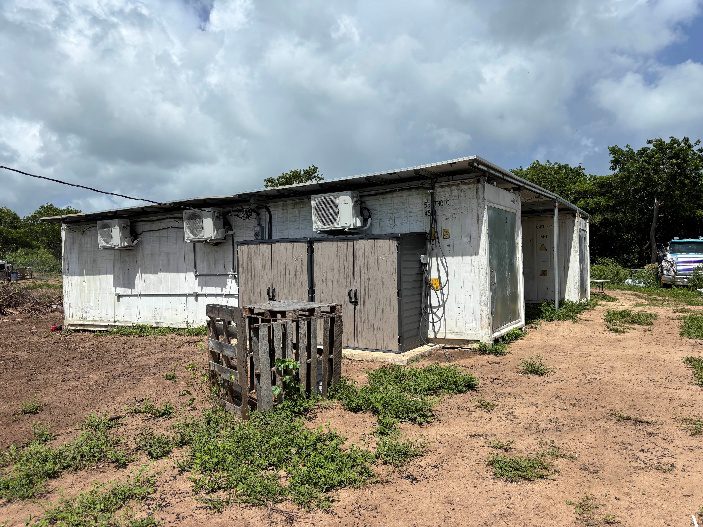
Van Den Hende believes that renewable energy has the potential to transform Puerto Rico’s energy crisis, and as an example, noted that a partnership with a non-profit community food security hub, La Finca de Hamberto, on the island of Vieques has been running continuously on a 100% solar-powered microgrid since October 2025.
One aspect of his work that motivates him most is seeing its direct impact on people’s lives. In the research environment where the results of one’s work may not be visible for a decade or more, Van Den Hende said it is “incredibly rewarding to be able to see the immediate impact of my work on the lives of others.”
Van Den Hende encourages students not to let fear stand in the way of pursuing a M.Eng. degree. He notes that some students may avoid considering engineering physics, for example, for fear that the curriculum will be exceptionally rigorous.
“I want prospective students to know that the program is incredibly flexible,” Van Den Hende said. “As a student, you have significant control over which courses to take to meet your requirements, and you design your own research project.”
Since receiving his M.Eng. degree, Van Den Hende remains involved with the Abruña Energy Initiative as a modeling and data engineer. The next phase of the Vieques project will install a second mobile battery for the microgrid system, and by early 2027 a green-hydrogen fuel cell system will make La Finca de Hamberto fully grid-independent, continuing to lay the initiative’s groundwork for eventually electrifying all of Vieques.