Lenan Zhang, assistant professor in Cornell’s Sibley School of Mechanical and Aerospace Engineering, has received a National Science Foundation Faculty Early Career Development (CAREER) Award to investigate a fundamental question in thermal science: How much heat can be transferred when a liquid becomes a vapor, or a vapor becomes a liquid?
The five-year project could lead to more efficient power plants, improved cooling systems for increasingly powerful computer chips, and advances in technologies ranging from water purification to air conditioning.
The CAREER Award is the foundation’s most prestigious award supporting early-career faculty who demonstrate the potential to become leaders in research and education. Zhang, who joined the Cornell Duffield College of Engineering in 2024, directs the Energy Research Laboratory.
At the center of Zhang’s research plan is a process called liquid-vapor phase change, which occurs when water evaporates or steam condenses. The process has been essential to industrial technology for centuries, from steam engines to modern electricity generation. It is also increasingly important for cooling the powerful processors used in artificial intelligence.
As computer chips become more powerful, they generate enormous amounts of heat in increasingly small spaces. Removing that heat is becoming a major obstacle to further improvements in computing performance.
One promising approach uses the large amount of energy absorbed when a liquid evaporates. But scientists still do not know the maximum rate at which heat can be transferred through this process.
“In order to push the limits of a process or technology, we need to know where those limits are,” Zhang said. “And right now, we don’t know this basic information.”
The problem is that theoretical predictions and experimental observations disagree dramatically. Computer simulations suggest heat can move across the boundary between liquid and vapor tens or even hundreds of times faster than experiments have demonstrated.
Part of the discrepancy comes from limitations on both sides, theoretical and experimental. Computer models often simplify the complex interactions between water molecules, while conventional experimental instruments cannot isolate what happens at the extremely thin boundary separating liquid from vapor.
Zhang’s CAREER project aims to resolve that disagreement by combining sophisticated computer modeling with experimental techniques borrowed from quantum chemistry, physics and biophysics.
Using water condensation as a test case, Zhang will develop simulations that describe the interactions of individual water molecules with unprecedented accuracy. Those molecular-scale calculations will then be connected to larger models that predict heat transfer through an entire system.
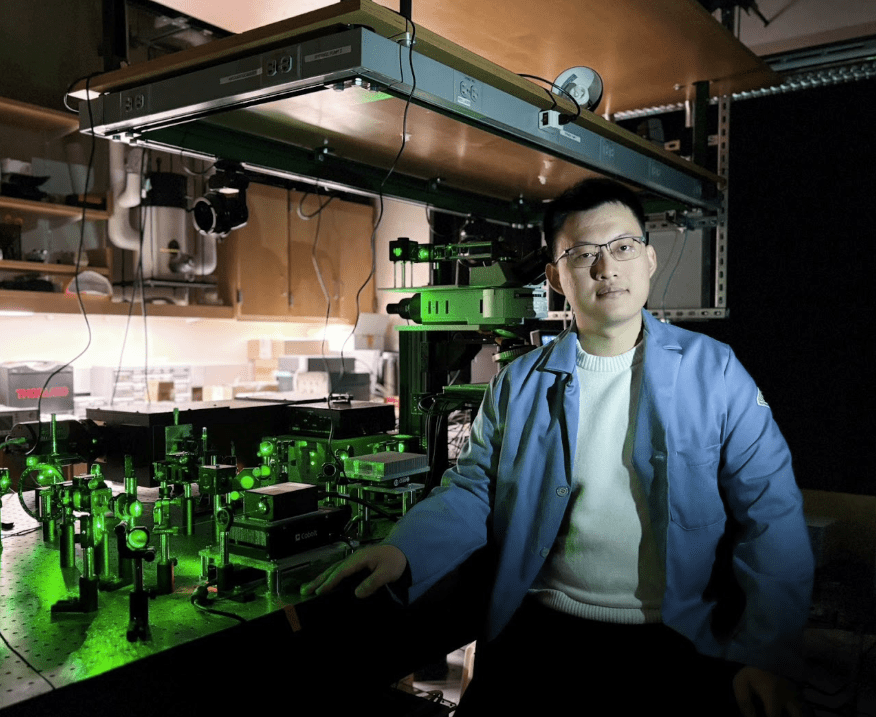
At the same time, his laboratory will develop optical instruments capable of measuring temperature and heat flow directly at the liquid-vapor boundary.
One technique, called interferometric scattering microscopy, will allow researchers to observe water droplets as small as 100 nanometers across, roughly one-thousandth the width of a human hair. By measuring how quickly those droplets grow, researchers can calculate how much heat is being transferred.
A second technique, called micro-Raman thermometry, uses laser light to detect molecular vibrations and, from those, determine temperatures at extremely small scales.
Together, the techniques should allow Zhang to compare experimental measurements with computer predictions under closely matched conditions, potentially resolving a longstanding disagreement in thermal science.
The approach reflects Zhang’s interest in bringing techniques developed in other scientific disciplines into thermal engineering. “It is important to me to stay aware of the tools used in other fields and then, if I see a chance to apply them in a new way, to do that to help fill in the missing details in some aspects of thermal science,” Zhang said.
Once the theoretical and experimental results agree, Zhang plans to identify the factors that prevent existing technologies from approaching the maximum possible rate of heat transfer. These include the effects of surrounding gases, droplet size and the resistance to heat flow within liquids.
His proposal suggests that understanding and controlling those factors could eventually produce more than a tenfold improvement in condensation heat transfer, although demonstrating such improvements remains a goal of the research.
The project also includes educational initiatives. Zhang plans to incorporate advanced optical measurement methods into graduate instruction, develop a project-based online summer course on multiscale modeling, and create research opportunities for students. Public outreach activities will include a partnership with Ithaca’s Sciencenter.
“Ultimately, I hope to be able to tell you where the fundamental limit of heat transfer is,” Zhang said, “and I want to provide a roadmap on how to approach this limit.” Such a roadmap could help engineers develop technologies that use energy more efficiently while meeting the growing cooling demands of modern computing and other technologies.