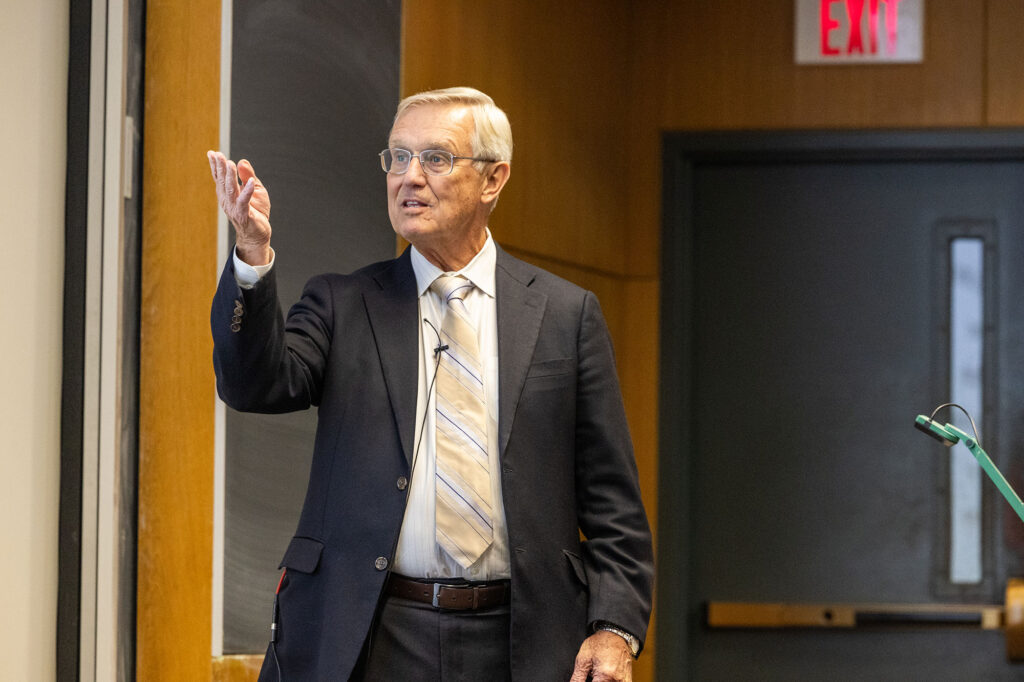
Former National Academy of Engineering president John L. Anderson delivered the 2026 Julian C. Smith Lecture in Chemical and Biomolecular Engineering, offering two perspectives on the role of engineering: one examining how technology advances scientific discovery and another exploring the physics behind the motion of microscopic particles.
In his public lecture, “Engineering’s Role in Creating Technology: Working in the Penumbra of Understanding,” Anderson argued that engineering is a goal-oriented discipline that respects science but is not always dependent on complete scientific understanding. Throughout history, he explained, technological advances have often preceded scientific explanations, with new technologies inspiring fundamental discoveries. Drawing on Theodore von Kármán’s observation that “Scientists discover the world that exists; Engineers create the world that never was,” Anderson examined the distinct but complementary roles of science and engineering while emphasizing engineers’ responsibility to develop technologies that benefit society and minimize unintended consequences.
Earlier in the day, Anderson presented the technical seminar, “Motility of Inanimate Particles,” highlighting research on the mechanisms that enable nonliving particles suspended in fluids to move in response to chemical and electrical gradients. He described the underlying principles of diffusiophoresis, electrophoresis, diffusioosmosis and electroosmosis, explaining how these transport phenomena can direct the movement of particles and fluids at microscopic scales with applications ranging from targeted particle transport to microfluidic systems.
Anderson served as president of the National Academy of Engineering from 2019 to 2025 following a distinguished academic career that included leadership roles as president of the Illinois Institute of Technology, provost at Case Western Reserve University and dean of engineering at Carnegie Mellon University. He began his academic career as a chemical engineering faculty member at Cornell and was elected to the National Academy of Engineering in 1992 for his contributions to the understanding of colloidal hydrodynamics and membrane transport phenomena.