Inertial Confinement Fusion: Ignition and Nuclear Astrophysics
Fusion ignition in the laboratory was recently achieved for the first time in inertial confinement fusion (ICF) using the high-energy-density (HED) laser platform at the National Ignition Facility (NIF). This talk will summarize these results as well as discuss the use of the HED platform for basic science experiments relevant to nuclear astrophysics. Thermonuclear reaction rates and nuclear processes have traditionally been explored by means of accelerator experiments, which are difficult to execute at conditions relevant to stellar or big bang nucleosynthesis. HED plasmas generated using lasers, e.g., at the NIF and OMEGA laser facilites, more closely mimic astrophysical environments in several ways, including with thermal distributions of reacting ions as opposed to mono-energetic ions impinging on a cold target; stellar-relevant plasma temperatures and densities; and, with the recent demonstration of ignition, neutron flux densities not found anywhere else on earth. This talk will present some initial nuclear astrophysics-relevant results for the T+T and solar 3He+3He reactions using this platform to illustrate the possibilities. Future directions, including platform developments to study CNO-cycle-relevant reactions including higher Z ions, neutron capture on nuclei in excited states and electron screening will also be discussed. The work was supported in part by NSF, the US DOE, LLE, and LLNL.
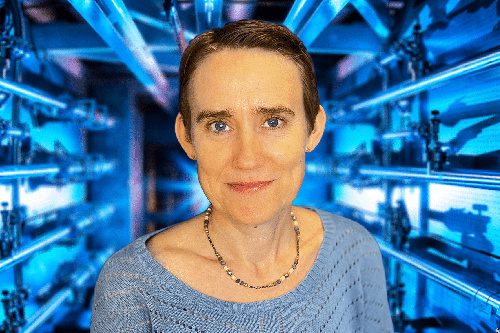
Bio: Maria Gatu Johnson is a principal research scientist and assistant director for career development and community building at the MIT Plasma Science and Fusion Center, where she develops and uses nuclear diagnostics to diagnose inertial confinement fusion (ICF) experiments. In particular, she has focused her efforts on working to understand stagnation physics in ICF implosions, helping guide the ICF program at the National Ignition Facility (NIF) to ignition and energy gain and the program at the OMEGA laser facility to record yields. Another primary focus of her work is plasma nuclear science-relevant basic-science experiments at OMEGA and the NIF. She also manages an accelerator laboratory at MIT dedicated to diagnostic development for ICF and high energy density physics (HEDP) experiments. She obtained her Ph.D. from Uppsala University, Sweden, in 2010, working on neutron diagnostics for the JET tokamak. She is the recipient of awards including the 2019 Katherine E Weimer Award and is a Fellow of the American Physical Society. She is proud to be an APS DPP Ally since 2019.