Epitaxial growth of c-BN on Diamond, an Ultra-Wide Bandgap Heterostructure
Cubic boron nitride (c-BN) is an ultra-wide bandgap semiconductor with properties similar to diamond and appropriate for high power and high frequency electronics. The 6.4 eV bandgap of c-BN projects a breakdown field > 12 MV/cm. Moreover, n-type doping with S and Si (~0.3eV) and p-type doping with Be and Mg (~0.24 eV) have been demonstrated. While there are no c-BN large area c-BN substrates, recent progress in diamond has enabled commercially available 25 mm diameter single crystal diamond wafers with 50 mm and 100 mm diameter diamond wafers anticipated in the near future. ASU has established a Diamond Lab with capabilities to deposit high purity intrinsic and doped diamond wafers. This talk will present our recent research efforts on epitaxial c-BN on diamond using ECR plasma enhanced CVD with a fluorine-based chemistry. Our research establishes relations between the precursor chemistry and the growth modes. By varying the ratio of the hydrogen and fluorine species, nucleation of c-BN on diamond can be achieved, which can then be evolved into growth at moderate rates of 50 nm/hr or more. In addition, we show that applied bias and nitrogen concentration are interrelated to achieve preference for cubic over hexagonal BN. The band alignment of c-BN on diamond is projected to depend on the interface bonding, and we describe our efforts to control the interface structure to optimize the c-BN-diamond band alignment. We describe how c-BN/diamond heterostructures could enable different electronic devices from power transistors to radiation detectors. Moreover, the devices are anticipated to operate in extreme environments (high temperature, high radiation, and corrosive environments).
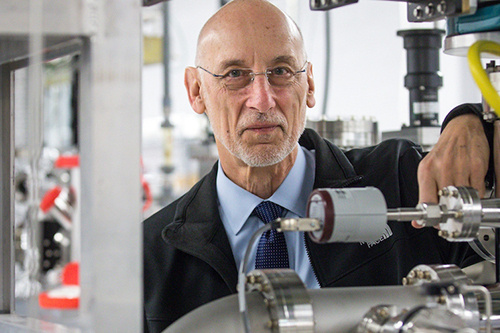
Bio: Robert Nemanich is Regents’ Professor in the Department of Physics at Arizona State University. He leads the US DOE funded Energy Frontier Research Center (EFRC) on ULTRA Materials for a Resilient Smart Electricity Grid. He has previously served as President of the Materials Research Society (MRS), and the chair of the APS Division of Materials Physics. He is Fellow of the American Physical Society and the Materials Research Society. His research is focused on growth, interfaces, phenomena and devices of diamond and ultra-wide bandgap materials.