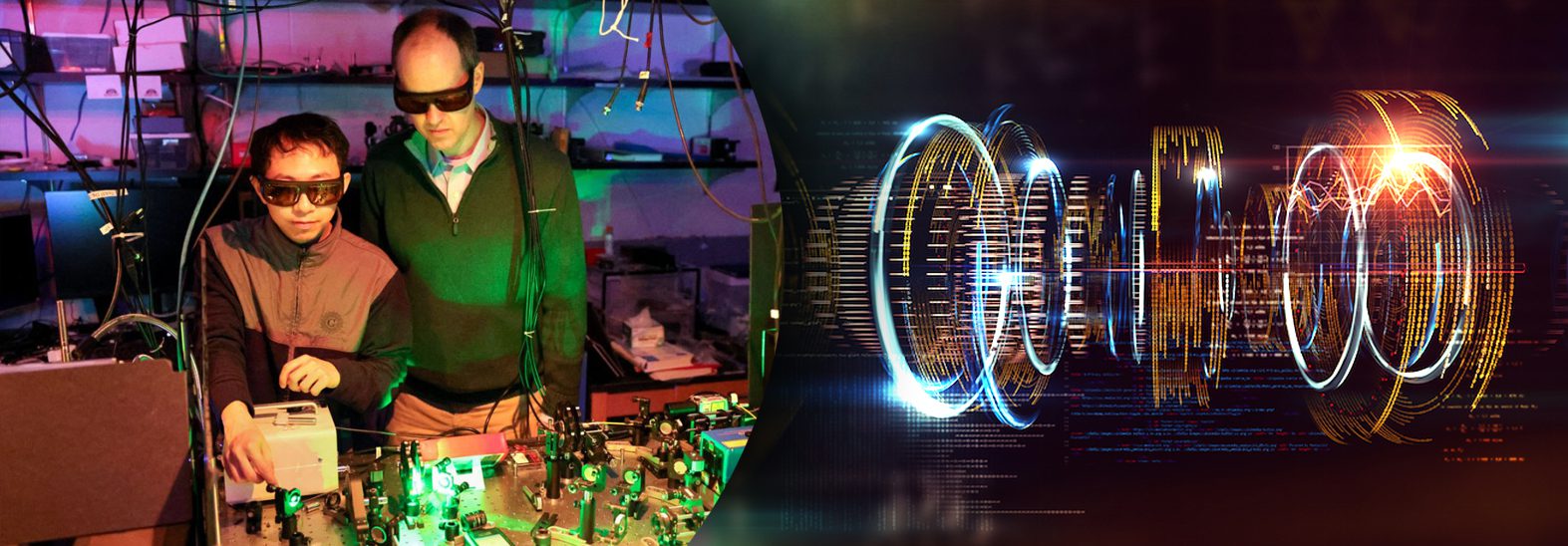
Expanding digital operations from a world of 0s and 1s to one that leverages the probabilistic states of quantum mechanics, quantum computing promises to transform the way we live by enabling advancements in drug discovery, climate modeling, cryptography and artificial intelligence. Cornell engineers, in collaboration with top scientists and engineers from universities, national laboratories, and industry, are at the forefront of advancing quantum science and technology, driving innovation and workforce development.
-
26
Duffield Engineering professor direct research labs studying quantum science and engineering.
-
.01
Degrees Kelvin is how cold Cornell’s cryogenic fridge operates to stabilize quantum states in qubits.
-
11
Academic partners, including Duffield Engineering, in the Q-NEXT quantum science consortium supported by the U.S. Department of Energy.
-
6
Degree programs with substantial content options in quantum science and engineering offered at Cornell.
Latest News
-
![]()
Quantum facility advances with $13.5M from Duffield Engineering
The buildout of a 10,000-square-foot quantum research facility at Cornell is advancing with a new $10 million investment from the Cornell Duffield College of Engineering, with an additional $3.5 million announced to support collaborative research projects.
-
Cornell co-founds new institute advancing quantum processor fabrication
MARQUIS, a new Quantum Leap Challenge Institute funded by the National Science Foundation, will develop the materials and manufacturing techniques needed to build quantum processors at scale.
-
A new ingredient for quantum computing: krypton gas
Researchers developed a method that uses krypton gas to slash the deposition temperature of the corrosion-resistant metal tantalum, resulting in thin films that have substantially higher electronic conductivity.

Select Centers and Facilities
Select Programs
- Minor
- B.S.
- M.Eng.On Campus
- M.Eng.Distance Learning
- M.S.
- Ph.D.
-
Applied Physics
Combines physics and engineering to develop technologies and solve scientific problems. Ideal for those interested in bridging fundamental science with real-world applications.
-
Engineering Physics
Combines engineering and physics to solve high-tech problems. Ideal for those interested in applying physics principles to developing innovative technologies.
-
Electrical and Computer Engineering
Focuses on developing electrical systems, from circuits to computers. Great for those interested in hardware, software, and advancing technology.
-
Materials Science and Engineering
Studies the properties of materials and their applications. Ideal for those excited about developing new materials for industries like electronics, energy, and healthcare.