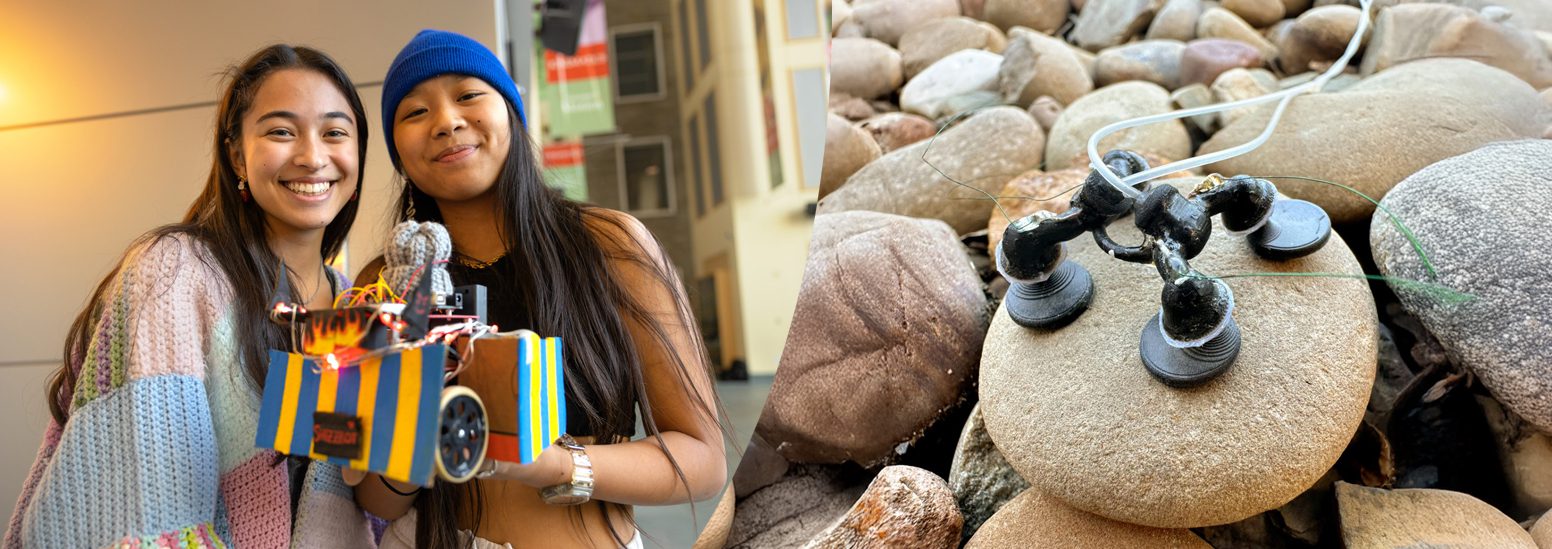
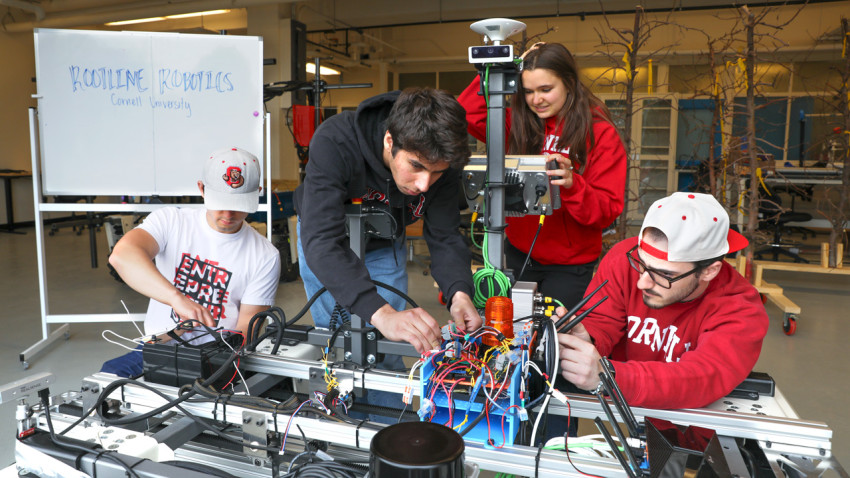
The science of autonomy, enabled by robotics systems, is shaping how humans drive cars, fly planes, pilot spacecraft, design and manufacture products, and much more. These changes are poised to transform nearly every industry, from health care to hospitality. We have long been at the forefront of these areas, with numerous robotics labs working to address issues of perception, control, learning, planning and human-robot interaction.
-
150
Students compete annually in the Mechatronics course robotics competition
-
100
The width in microns (smaller than an ant’s head) of an autonomous solar-powered microrobot engineered at Cornell.
-
3,100,000
Views on Cornell roboticist Guy Hoffman’s TED Talk titled “Robots With Soul.”
-
12
Rovers engineered by the Cornell Mars Rover student project team since 2010.
Featured News
-
![Andrew James ’26 (from left), Neil Morrison ’28, Natalia Kurz ’29 and Michael Neiss ’27 work on a prototype of their weed-killing robot ahead of The Farm Robotics Challenge, which they won on May 21.]()
Undergrads’ weed-killing robot wins top prize
A team of Cornell students bested the competition with their invention: an autonomous robot that kills weeds with electricity.
-
Robotic ‘matter’ flows, adapts through mechanical intelligence
Cornell engineers have developed a robotic collective that behaves less like a machine and more like a material that flows, reshapes and adapts to its environment without centralized control.
-
Handle with care: Soft robot gripper picks ripe fruit without bruising
Cornell researchers used stretchable fiber-optic sensors to create a soft robot gripper that can predict the ripeness of strawberries by touch, then pick them without causing any damage.
Select Centers and Facilities
Select Programs
- Minor
- B.S.
- M.Eng.On Campus
- M.Eng.Distance Learning
- M.S.
- Ph.D.
-
Mechanical Engineering
Involves the design and analysis of machines, engines, and systems. Perfect for those fascinated by motion, energy, and innovative mechanical solutions.
-
Aerospace Engineering
Involves designing and testing aircraft and spacecraft. It’s ideal for those excited by flight, space exploration, and advancing technologies in propulsion and aerodynamics.
-
Electrical and Computer Engineering
Focuses on developing electrical systems, from circuits to computers. Great for those interested in hardware, software, and advancing technology.
-
Computer Science
Studies computing systems, software, and algorithms. Great for those excited by innovation in technology, problem-solving, and advancing digital solutions.
-
Systems Engineering
Focuses on designing and managing complex systems. Ideal for those interested in coordinating processes to create efficient, scalable solutions for global challenges.