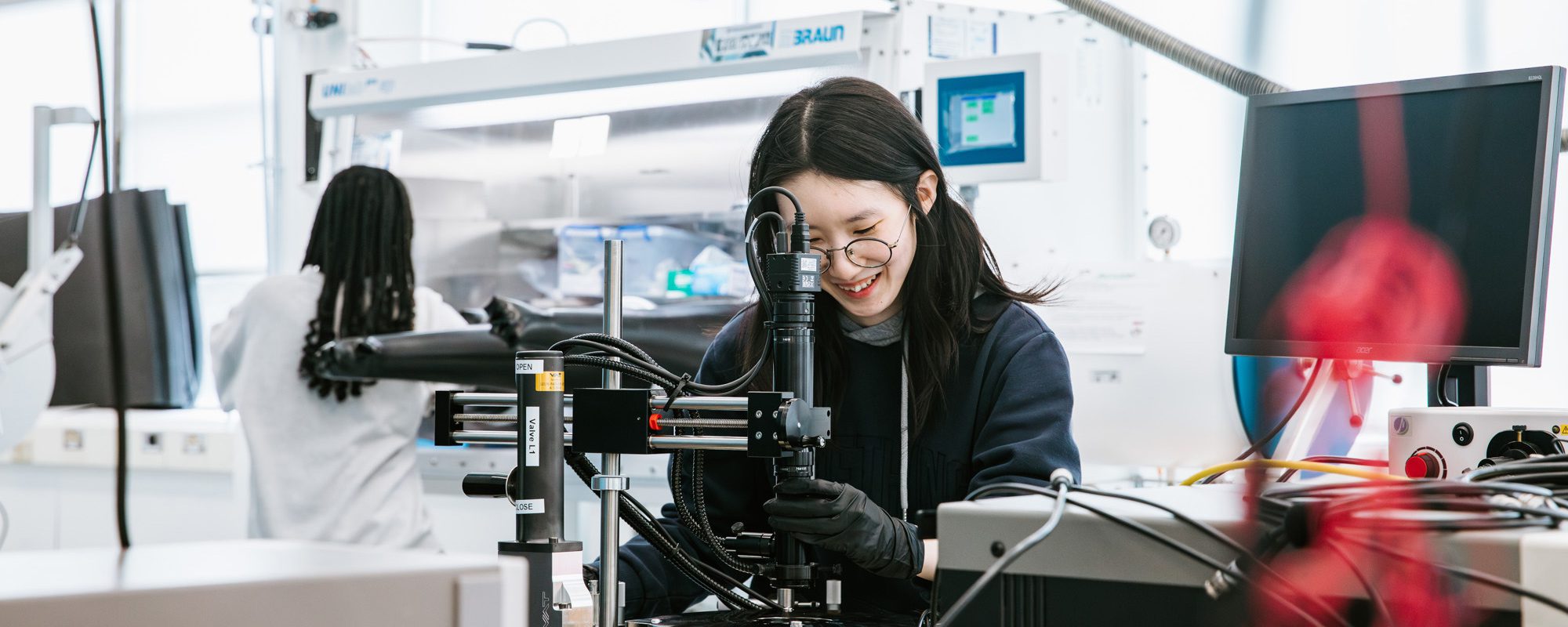
In less than a year, you’ll gain advanced technical expertise, sharpen your professional skills, and build a network that positions you to succeed.
-
Small, Connected Cohorts
Our intentionally small class sizes foster collaboration with expert faculty, accomplished peers, and industry mentors. Your goals guide your journey and success is supported every step of the way.
-
World-class Resources and Expertise
As part of Cornell Duffield College of Engineering, you’ll learn from renowned faculty and access cutting-edge research facilities that drive innovation in materials science and beyond.
-
Everything is Made of Something
No matter your background — materials science, physics, chemistry, or engineering — this program prepares you for impact in manufacturing, energy, aerospace, biomedical devices, and beyond.
A One-Year Program With Three Essential Pillars
-
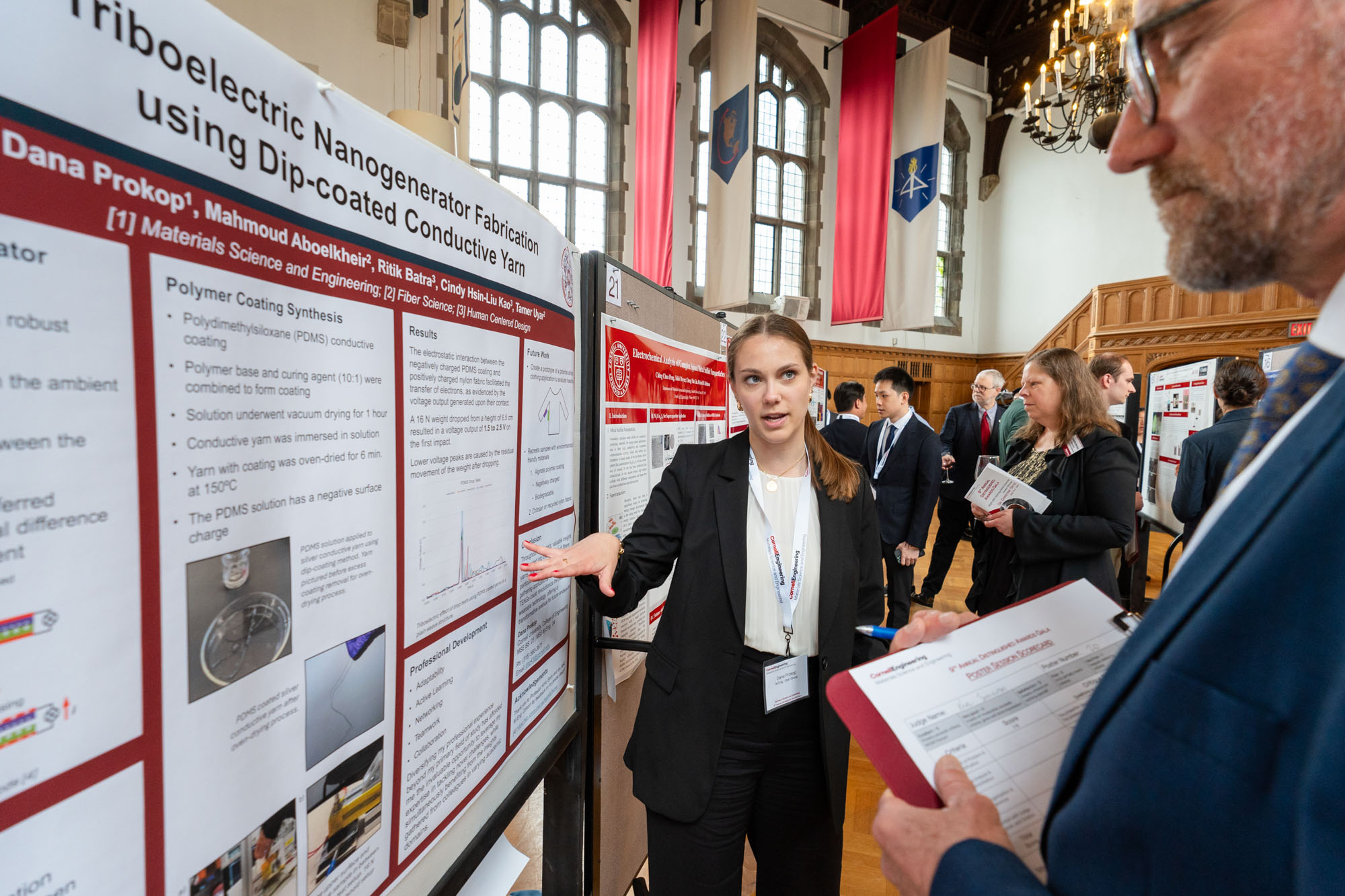
![MSE student discussing their research poster during the distinguished awards gala]()
Hands-on Capstone Project
Instead of a traditional research thesis, each student completes a capstone project, which is selected through a process involving both the student and project sponsor.
This project is a unique opportunity for students to get hands-on experience solving a real-world problem of significance. Students typically have several options to choose from, including projects sponsored by Cornell faculty, local industry partners, and a project-based entrepreneurship course.
-
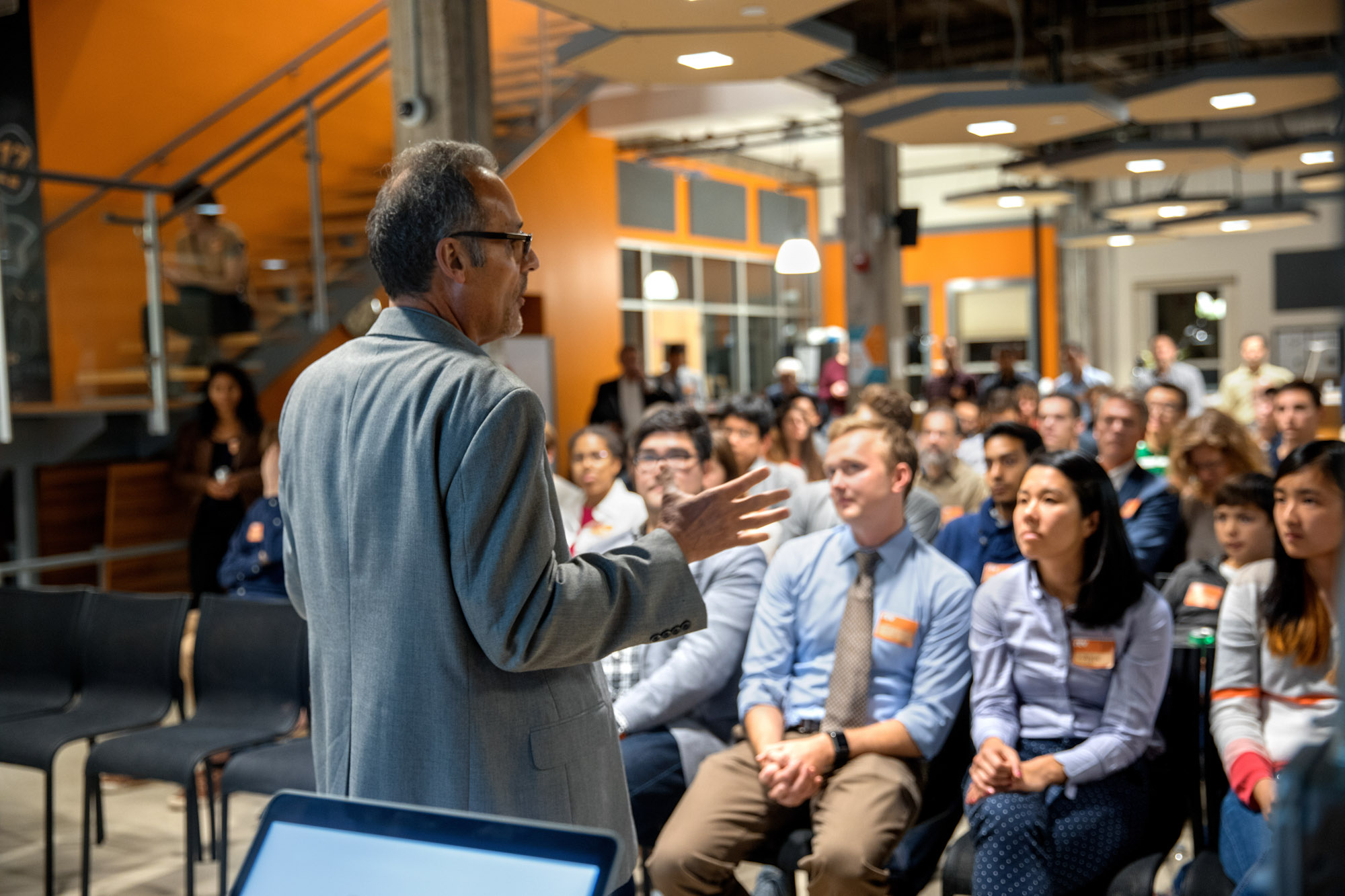
![Professor Emmanuel Giannelis speaking to a group of students at a Networking at Rev Advancing University Technologies event]()
Professional Development
As part of our commitment to implementing a comprehensive professional program, the M.Eng. curriculum includes two semesters of the Professional Development Seminar. In this course, students engage in active-learning topics such as networking, emotional intelligence, salary negotiation, and more.
Our M.Eng. program also works together with the Cornell Team and Leadership Center, for both orientation and seminars, to construct a unique curriculum that prepares students to maximize their effectiveness in the workplace.
-
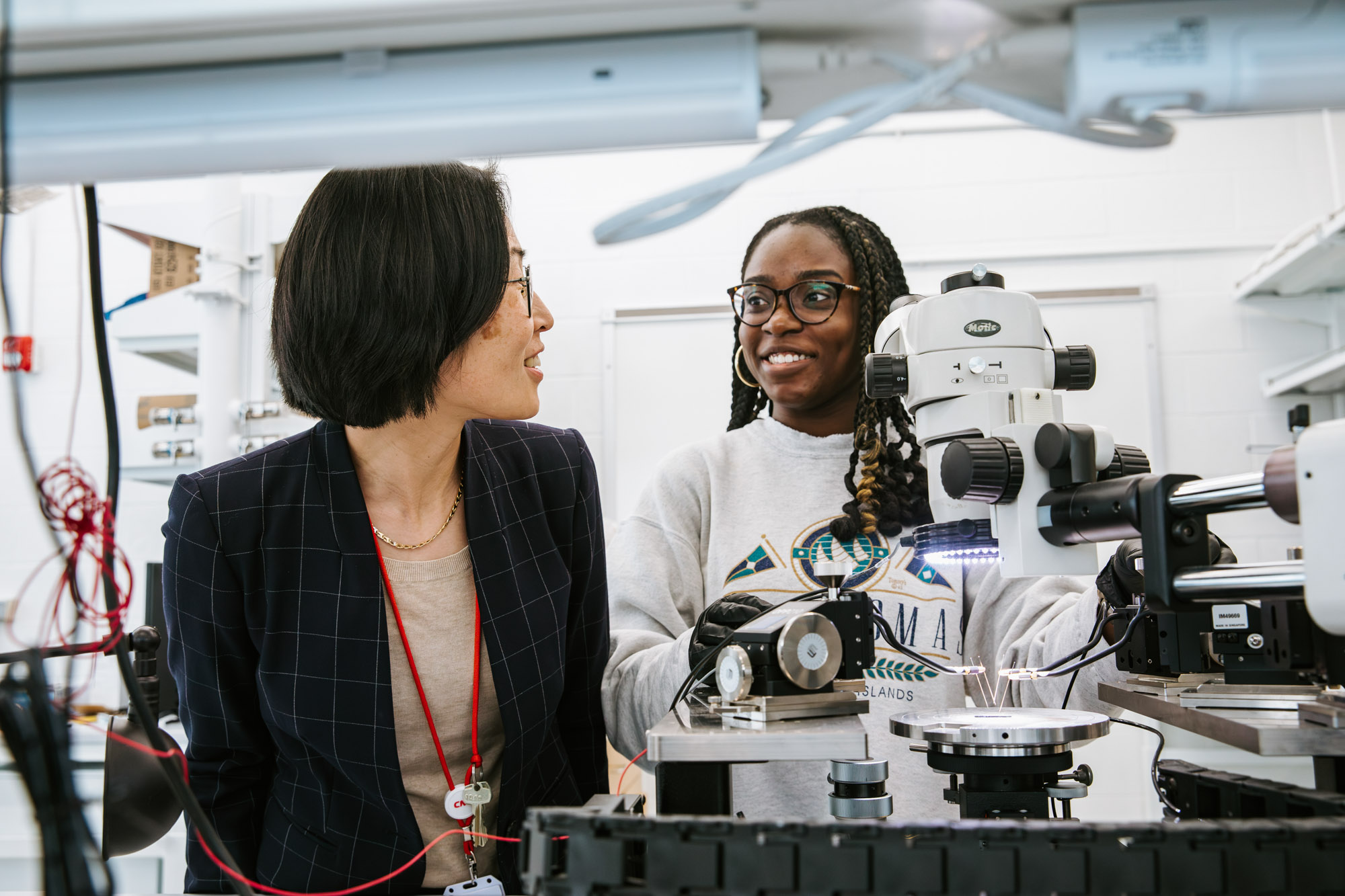
![Professor Judy Cha working with a student in her research lab]()
Flexible Graduate-Level Coursework
Our M.Eng. is a flexible program, where students customize their course load based on their unique interests, while working closely with their faculty advisor to develop a curriculum that best fits their needs.
Typically, students take six to eight graduate-level instructional courses. Many of these are courses taught by the Materials Science and Engineering department, but students are also encouraged to take technical electives from other departments at Cornell.
Master of Science vs. Master of Engineering – What’s the Best Fit for you?
Both the Master of Science (M.S.) and Master of Engineering (M.Eng.) are rigorous graduate degrees, but they’re designed for different goals and learning styles. If your goal is to conduct original research and explore academic or research-intensive careers, the M.S. may be the right fit. If you’re looking to build applied skills, work on real world problems, and move quickly into an industry career, the M.Eng. offers a focused, experience-driven path forward.
-
The M.Eng.: Non-Thesis, Project-Based Learning
- 2–3 semesters, often completed in less than a year
- Focused on professional practice and leadership skills
- Prepares you for industry or entrepreneurial roles
- Hands-on project: Instead of a traditional thesis, M.Eng. students complete hands-on, team-based or individual projects that reflect how engineering work happens in industry, startups, healthcare, and public-facing organizations.
-
The M.S.: Thesis-Based Research
- Typically 2 or more years
- Focused on research and academic inquiry
- Often leads to Ph.D. or research positions
- Research thesis: Students typically work closely with a faculty advisor over multiple semesters to develop and defend a research thesis.
Spotlights
-
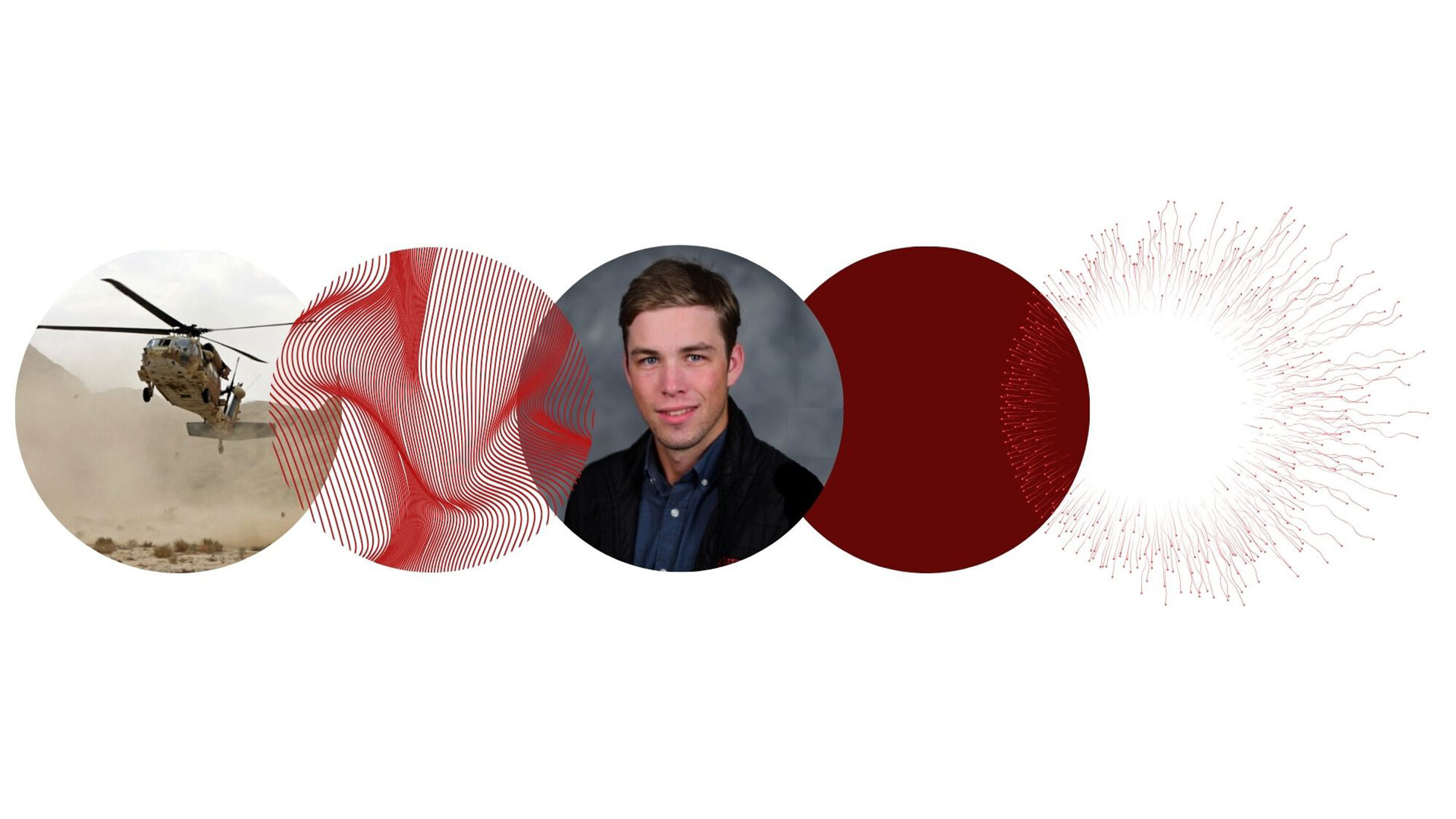
![Collage with M.Eng. student Thor Oase and a helicopter]()
A Passion for Materials Leads to Industry Collaboration in M.Eng. Project
Thor Oase is a graduate student in the Cornell Materials Science and Engineering M.Eng. program from Apple Valley, Minnesota. He earned his Bachelor of Science in Mechanical Engineering from University of California, Berkeley. He is currently collaborating with NASA and Innovative…
Featured Employers
- Adidas
- A123 Systems
- Applied Materials
- BYD
- Corning
- Deloitte
- Estee Lauder
- Extrel CMS
- Good Housekeeping Institute (Hearst Corporation)
- GSX
- IMR Test Labs
- Intel
- Lululemon Athletica
- Macom
- Micron
- Microport
- Tetra Pak
- TSMC
- Yangtze River Ecological Environment Engineering Research Center
Job Title Examples
- Associate Research Engineer
- Autometrology Engineer
- Battery Engineer
- Business Technology Solutions Analyst
- Field Service Engineer, Research Applications
- Footwear Innovation Engineering Assistant
- Integration Engineer
- Material Manager
- Metallurgical Engineer
- Nuclear Data Analyst
- Packaging R&D Engineer
- Process Engineer
- Product Engineer
- Semiconductor Process Engineer
- Senior Analyst, Package Testing
- Senior R&D Engineer
- Structural Materials Engineer
- Textiles Product Review Analyst
Contact Us
-
Assistant Director of Graduate Programs
Jannica Moskal
Bard Hall, Room 210
Ithaca, NY 14853-1501
mse-meng@cornell.edu