- Graduate Field Affiliation
- Geological Sciences
Biography
Patrick Fulton is an associate professor in Cornell University’s Department of Earth and Atmospheric Sciences and a Croll Sesquicentennial Fellow. His research focuses on heat and fluid flow within the Earth, particularly within faults and fractured rocks, and what these processes can reveal about earthquakes, subsurface hydrogeology, and geothermal energy resources. Much of his work involves making measurements deep within the Earth, developing borehole observatories for long-term temperature and pressure monitoring, and using these observations to characterize subsurface processes and conditions.
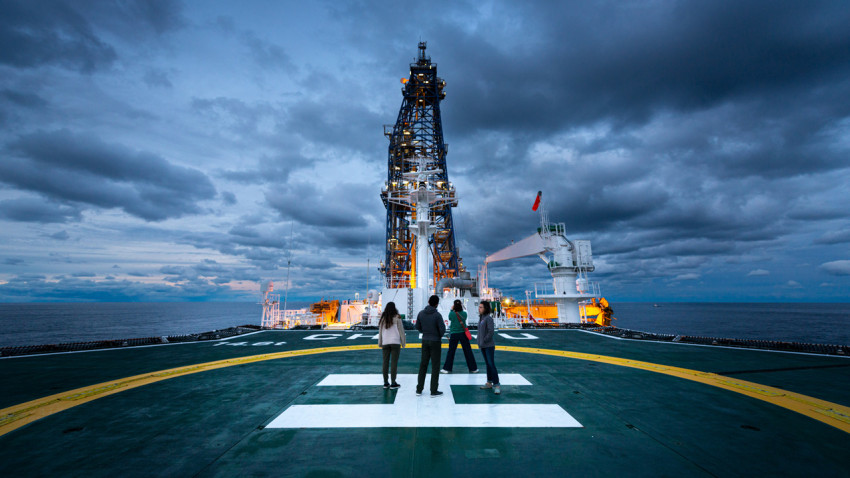
Fulton has been extensively involved in scientific drilling and borehole observatory projects, including work at the Japan Trench and the Hikurangi subduction margin of New Zealand. He played a leading role in the Japan Trench Fast Drilling Project (JFAST), which measured the frictional heat generated by the 2011 Tohoku-oki earthquake, and served as co-chief scientist of the 2024 JTRACK drilling expedition and a subsequent 2025 expedition to extend monitoring of Japan Trench borehole observatories. At Cornell, his work also includes deep geothermal exploration, research at the Cornell University Borehole Observatory, and investigations of fluid flow and thermal processes in geothermal reservoirs.
Research Interests
Fulton’s research combines field observations, borehole instrumentation, laboratory measurements, and physical modeling to investigate the thermal and hydraulic behavior of faults and fractured rocks. His work explores the role of heat and fluids in earthquake processes, how fault zones respond to earthquakes and slow slip, and how temperature and pressure observations can be used to characterize subsurface permeability and fluid flow. His research also includes measuring and interpreting the thermal properties of rocks, including thermal conductivity, diffusivity, and heat capacity, to better understand subsurface temperature distributions and heat flow. Related work applies these approaches to geothermal energy, including the characterization of deep geothermal systems, development of methods for interpreting borehole temperature records, and understanding and managing fluid flow within fractured reservoirs.
Select Publications
-
Fulton, P.M., and M. Fresonke (2026). Low heat flow near the deformation front of the northern Hikurangi margin revealed by deep borehole observatories. Geochemistry, Geophysics, Geosystems, 27, e2025GC012750.
-
Purwamaska, I., and P.M. Fulton (2026). Borehole thermal recovery as a method for quantifying subsurface permeability. Geochemistry, Geophysics, Geosystems, 27, e2025GC012508.
-
Clairmont, R.D., and P.M. Fulton (2025). Permeability of the Pāpaku fault within the Hikurangi subduction zone determined from the thermal response to a free flowing well test. Journal of Geophysical Research: Solid Earth, 130, e2024JB030965.
-
Fulton, P.M., E.E. Brodsky (2016), In situ observations of earthquake-driven fluid pulses within the Japan Trench plate boundary fault zone, Geology, G38034.1, doi:10.1130/G38034.1
-
Fulton, P.M., et al. (2013), Low Coseismic Friction on the Tohoku-Oki Fault Determined From Temperature Measurements. Science, 342, 1214-1217.
Select Awards and Honors
- Daniel M. Lazar ’29 Excellence in Teaching and Mentoring Award, Cornell University, Duffield Engineering 2023
- Croll Sesquicentennial Fellow 2019
- Consortium for Ocean Leadership Distinguished Lecturer for the Integrated Ocean Drilling Program (IODP). 2014-2015
- Jason Morgan Early Career Award, American Geophysical Union, Tectonophysics Section. 2014
Education
- A.S. Science, Young Harris College 1999
- B.S. Earth and Atmospheric Sciences, Georgia Institute of Technology 2001
- Ph.D. Geosciences, The Pennsylvania State University 2008