Page Contents
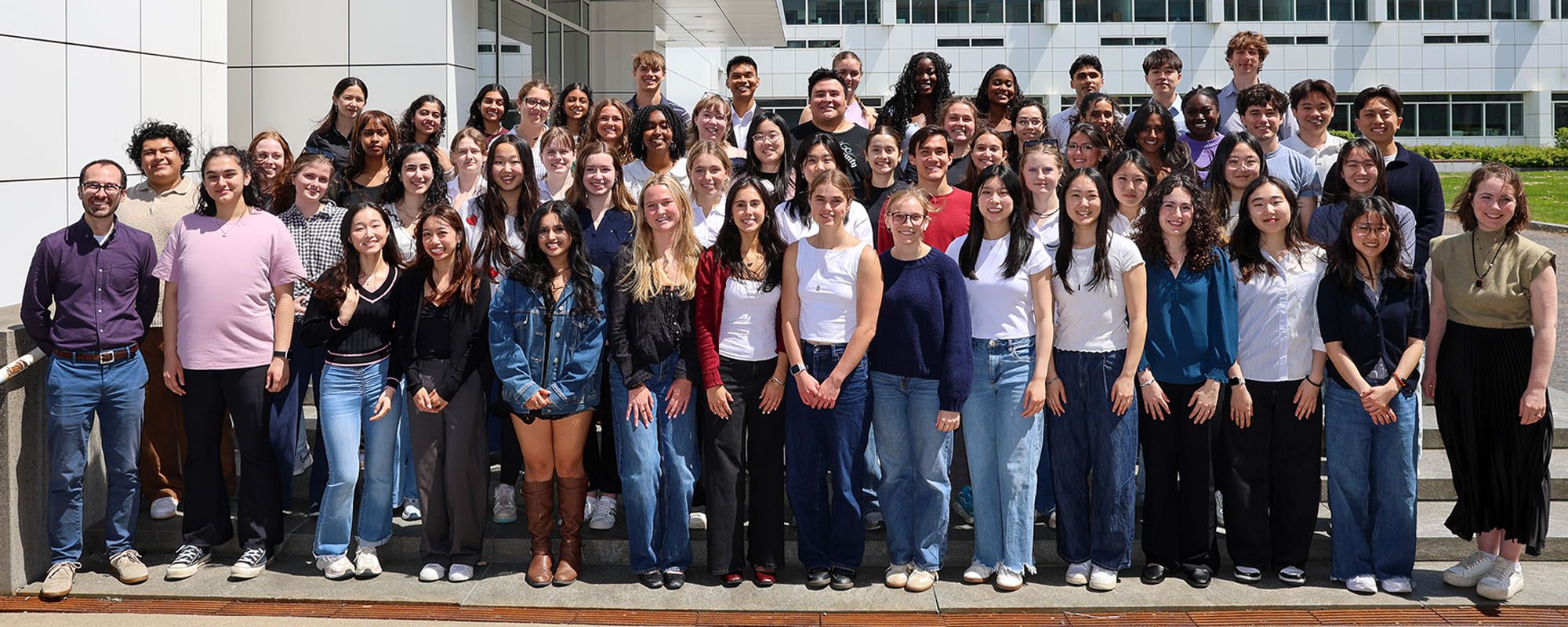
Bachelor of Science 2026
Graduates
Monalisa Almeida
Dorin Artzi
Ariella Avigad
Rahul Barpanda
Marisa Bobal
Anmolika Bolla
Adelin Chan
Angelina Chan
Vivian Cho
Victoria Cotton
Gabriel Czako
Priyanka Desai
Katrin Donetski
Noon Elbedawi
Viviana Esquivel
Marcus Gamboa
Alexandra Griffin
Jillian Hargarten
Lauren Holt
Jun-Young Hong
Sarah Kazmi
Lucas Keith
Rita Kelly
Jordan Khan
Emma Khidr
Caroline Lamb
Justin Lau
Joshua Lee
Emma Leung
Richard Lin
Ryan Lyppens
Sibel Makineci
Laila Martinez
Jiatong Mei
Maha Mohamed
Claire Nasieb
Dawn Ndubuisi-Ike
Elizabeth (So Young) Oh
Ivie Osagie
Annabelle Owusu
Arya Patel
Xinrui Peng
Lauren Richardson
Connor Roche
Ariana Samuels
Ally Schwartz
Aiko Shibata
Caitlin Sigda
Elizabeth Snavely
Audrey Struzyk
Ella Sultan
Hazuki Takahashi
Kira Titova
Alice Wei
Emma Weiss
Mei Ling Wood
Shanie Zeltzer
Senior Design Projects
The yearlong senior capstone course showcases students’ engineering skills by diving into a real-world biomedical engineering problem. Students learn design through case studies, activities, and a project. They pick a project idea based on their interests, current events, or insights from clinical and exchange programs. Teams work together to understand their project’s needs, engage with stakeholders, and build a prototype using hands-on skills, quantitative approaches, project management skills, and following ethical standards, as well as considering intellectual property. Teams showcase their projects in a video infomercial, as well as a detailed technical report, and answer questions from peers and faculty.
-
Adaptacool — Perforated Silicone Liner with Wicking Channels
Monalisa Almeida, Ariella Avigad, Marisa Bobal, Victoria Cotton, Viviana Esquivel
Excess moisture buildup inside lower limb prosthetic sockets remains a major challenge for amputees, often leading to discomfort, skin irritation, odor, infections, and reduced prosthesis use. Approximately 2.3 million people in the United States live with limb loss, with over 90% involving the lower limb. Conventional prosthetic liners create a sealed microenvironment that traps sweat and humidity against the skin, while many current solutions either fail to directly remove liquid sweat or rely on bulky active cooling systems that introduce added weight, cost, and complexity. Adaptacool addresses this gap through the development of a passive silicone prosthetic liner with integrated microperforations, enclosed vertical wicking channels, and removable moisture wicking rope inserts attached to a sweatband designed to transport sweat away from the residual limb. The project focused on balancing moisture management performance with comfort, durability, manufacturability, ease of cleaning, and compatibility with existing prosthetic systems. Multiple flat sheet, cylindrical, and ergonomic silicone prototypes were iteratively designed, fabricated, and tested to evaluate perforation geometry, channel configurations, mold manufacturability, fluid transport, and liner wearability. Preliminary testing demonstrated the feasibility of passive directional sweat transport while maintaining liner integrity and user comfort.
-
![A trophy.]()
BioBeeTack — Alternative Skin Fixation for Optimal Wound Healing
*Best Prototype Award*
Jordan Khan, Dorin Artzi, Damian Pulla Galan, Shanie Zeltzer, Audrey Struzyk
BioBeeTack is a bioinspired graft fixation system designed to improve skin graft stability while enabling localized drug delivery at the graft site. The project combines a barbed tack geometry for improved shear-resistant fixation with a PLGA-based dip coating capable of sustained therapeutic release. CAD-designed and resin-printed tacks were evaluated through push-in, pull-out, tensile, and fixation testing using multiple tissue models and the Instron system. In parallel, PLGA/Rhodamine B coatings were developed to study coating uniformity, diffusion behavior, and release profiles. The project demonstrated proof-of-concept integration of mechanical fixation and localized drug delivery into a single biodegradable platform with potential applications in graft stabilization and wound healing.
-
Crushy — At-Home Pill-to-Gummy Device
Adelin Chan, Emma Khidr, Gabriel Czako, Anmolika Bolla, Aiko Shibata
Difficulty swallowing pills presents a significant challenge for pediatric patients, often leading to poor medication adherence and reduced treatment effectiveness. Current alternatives, such as crushing pills manually or using liquid formulations, can be inconvenient, inconsistent, or unavailable for many medications. To address these limitations, we developed a prototype device that converts pills into an easier-to-consume gummy form through an integrated grinding and mixing process. The device grinds pills into a fine powder into a mixing chamber, where a motor-powered mixer combines the medication with water and gelling powder to form a consumable gummy. Our design aims to improve medication accessibility, simplify administration, and provide a more patient-friendly alternative to traditional oral dosage forms. By integrating pill crushing, mixing, and gummy formation into a single system, this approach has the potential to enhance medication compliance and improve the overall patient experience.
-
ElastiGait — Redesigning a Brace for Children with Cerebral Palsy
Laine Hargarten, Arya Patel, Maha Mohamed, Lauren Holt, Ally Schwartz
Cerebral palsy affects an estimated 800,000 individuals in the United States and is the most common cause of childhood physical disability worldwide, frequently presenting with drop foot, toe drag, and progressive Achilles tendon shortening due to spasticity and impaired motor control. Current ankle foot orthoses on the market often sacrifice comfort and compliance by immobilizing the ankle rather than supporting functional motion. ElastiGait addresses this gap through a pseudo-tendon AFO design featuring a lightweight rigid shell and interchangeable elastic straps secured via click-and-lock fixtures, which act as a synthetic tendon to promote active dorsiflexion during swing phase and resist excessive plantar flexion during stance phase. By enabling natural gait mechanics rather than compensating around them, ElastiGait reduces the risk of adaptive tendon shortening, improves user safety, and offers a tunable, patient-friendly alternative to existing devices.
-
Kidney Health at Home — At-Home, In-Toilet Urine Screening
Ryan Lyppens, Caroline Lamb, Alice Wei, Hazuki Takahashi, Vivian Cho, Kelly Mei
Chronic kidney disease (CKD) affects ~800 million people and is responsible for 1.5 million deaths worldwide. CKD patients suffer from late diagnosis due to the asymptomatic progression of the disease and infrequent testing. They are often diagnosed when the only treatment options are dialysis or transplant surgery. Therefore, it is imperative to increase the testing frequency for CKD.
Current testing methods (bloodwork, urine test, and manual dipstick) are invasive and inconvenient, leading to poor patient compliance. A non-invasive and convenient testing option is needed to increase patient compliance. Therefore, we propose an automated, at-home device that performs weekly dipstick testing to measure urinary albumin-creatinine ratio (uACR), an indicator of early-onset CKD. By continuously monitoring large populations and generating referrals to physicians when necessary, we aim to increase early detection of CKD and improve patient outcomes.
-
LIVeLine — Rethinking IVs
Alexandra Griffin, Jay Hong, Justin Lau, Emma Leung, Richard Lin, Kira Titova
Intravenous therapy is one of the most common clinical interventions, yet routine IV administration harbors two persistent and largely unaddressed inefficiencies. First, when a saline bag runs dry before nursing staff can intervene, air enters the IV line. If too much air enters the line, a full line replacement is required, wasting supplies and pulling nurses away from other patient care responsibilities. Second, short-push IV medications requiring controlled delivery over one to five minutes are routinely administered too rapidly, as most clinicians lack a practical tool to enforce proper timing and do not want to spend five minutes manually pushing medication while tracking the infusion rate by watch. To address both issues, we developed two low-cost, easy-to-use devices. The first is a device that contains a drip chamber sensor that continuously monitors fluid levels in the drip chamber and clamps the IV line the moment a saline bag runs dry, preventing air from entering the line entirely and eliminating the need for replacement. The second is a mechanical syringe pump that provides consistent, controlled delivery rates for short-push medications, ensuring clinicians administer drugs at the correct rate without relying on manual estimation or electronic infusion equipment. Together, these devices target the gap between established safe practice guidelines and real-world clinical behavior, aiming to reduce wasted nursing time, minimize supply waste, and improve medication administration safety across a range of clinical settings.
-
![A trophy.]()
TactTissue — The Medical Surgical Training and Evaluation Device
*People’s Choice Award*
Lucas Keith, Sarah Kazmi, Claire Nasieb, Priyanka Desai, Marcus Gamboa
TactTissue is a project focused on improving surgical training through objective, real-time performance feedback. Current surgical training models often rely on residents practicing on static slabs of tissue with little opportunity for continuous feedback, limiting access to personalized evaluation outside of direct instructor observation. To address this gap, TactTissue combines realistic synthetic tissue materials with embedded sensing technology to create interactive surgical simulators modelling a soft tissue sarcoma resection, dental extraction procedure, and suturing. The system tracks metrics including procedure time, vessel hits, and applied pressure, while also simulating clinical consequences such as bleeding and bruising. Following each session, users receive a quantitative performance score and targeted improvement recommendations. By transforming surgical practice into measurable, data-driven training, TactTissue aims to improve technical precision, accelerate skill development, and ultimately contribute to safer patient care.
-
![A trophy.]()
SternaTwist — Fast, Reliable Sternal Closure Device
*Best Pitch Award*
Emma Weiss, Mei Ling Wood, Elizabeth Snavely, Katrin Donetski, Joshua Lee, Angelina Chan
Median sternotomy is the standard surgical approach for many open-heart procedures and is commonly closed using stainless steel wire cerclage. However, surgeons currently rely on manual feel to determine wire tightness, which can lead to inconsistent closure forces and increase the risk of sternal instability, pain, wire cut-through, and post-operative complications. To address this limitation, we developed SternaTwist, a force-limiting wire closure device designed to provide more controlled and reproducible sternal wire tightening while maintaining compatibility with existing surgical workflow. Verification testing was performed using a custom benchtop sternum model and with force measurement systems to evaluate repeatability and closure performance. By improving consistency during sternotomy closure, SternaTwist aims to support safer healing outcomes and reduce complications associated with traditional manual wire tightening.
-
WoundWise — Rapid, Point-of-Care Infection Testing
Elizabeth Oh, Lauren Richardson, Sibel Makineci, Rita Kelly, Ivie Osagie, Annabelle Owusu
WoundWise is an at-home wound infection detection system designed to improve early identification of wound infections outside traditional clinical settings. The project integrates an absorbent wound dressing, optimized buffer transfer workflow, and lateral flow assay into a single patient-centered diagnostic platform. Users collect wound exudate through a removable sampling port within the dressing, transfer the sample into a stabilization buffer using a sterile swab, and apply the solution to a lateral flow test for rapid visual readout. The system was developed to reduce reliance on subjective visual wound assessment and support earlier intervention in home-care, rural, and resource-limited settings. Through iterative prototyping and testing, the team evaluated bandage materials, swab transfer efficiency, buffer formulations, bacterial transfer performance, and usability workflows to optimize comfort, reproducibility, and ease of use. WoundWise demonstrates the feasibility of a low-cost, accessible infection screening workflow that bridges wound care and rapid point-of-care diagnostics.
-
AYE-I — An AI Healthtech Screening Watchdog
Rahul Barpanda, Laila Martinez, Horacio Montes, Iris Peng, Connor Roche
As AI chatbots become more common in everyday health decision-making, patients may rely on them for symptom guidance, reassurance, or next steps before speaking with a clinician. This creates a new safety problem: unlike medical devices or clinical workflows, many AI health tools are difficult to evaluate in a consistent way. A response that sounds confident or empathetic may still miss warning signs, underestimate urgency, or give advice that is not appropriate for the patient’s situation. For nurse-style AI triage systems, this risk is especially important because the output may shape whether someone calls 911, seeks urgent care, schedules a doctor’s visit, or does nothing.
Aye-I is a senior design project focused on building a structured way to test and grade AI nurse-bot responses before they are trusted in real-world care settings. The system uses realistic patient personas, scenario-based prompts, and a rubric that evaluates not only medical accuracy, but also urgency, safety, empathy, clarity, and whether the AI appropriately redirects users to human care. Rather than creating another nurse bot, Aye-I functions as a watchdog and evaluation platform for the bots that already exist or may soon enter the healthcare space. The project also includes an AI literacy website for middle and high school students, designed to help future users understand where AI can be helpful, where it can fail, and why human judgment remains essential in medical contexts. Overall, Aye-I aims to make healthcare AI safer by creating tools for both technical evaluation and public education.
-
FlowSure — New Vaginal Suppository Design for Bacterial Vaginosis
Ella Sultan, Noon Elbedawi, Caitlin Sigda, Dawn Ndubuisi-Ike, Ariana Samuels
Bacterial Vaginosis (BV) and many other vaginal conditions stem from vaginal microbiome imbalance, in which Lactobacillus, the primary “good” bacteria native to the vagina, is severely depleted, thus raising the vaginal pH and increasing the susceptibility to further infection. These affect nearly 30% of women in the United States between the ages of 14 and 49 (Fadayomi, 2024). Current treatment methods rely heavily on antibiotics, which may temporarily eliminate harmful bacteria but also disrupt the healthy vaginal microbiome. This can lead to recurring infections and further imbalance. Our solution, FlowSure, is a vaginal hydrogel suppository designed to restore and maintain a healthy vaginal microbiome through localized probiotic delivery. The suppository releases Lactobacillus intended to improve vaginal pH and overall microbiome balance. Our hydrogel-based design provides hydration and softness during use, while the removable structure minimizes leakage and improves convenience. FlowSure differentiates itself by prioritizing preventative care, microbiome restoration, and user comfort all in one product.